




CCE: Amnesty must be an exception, not a space for political calculations

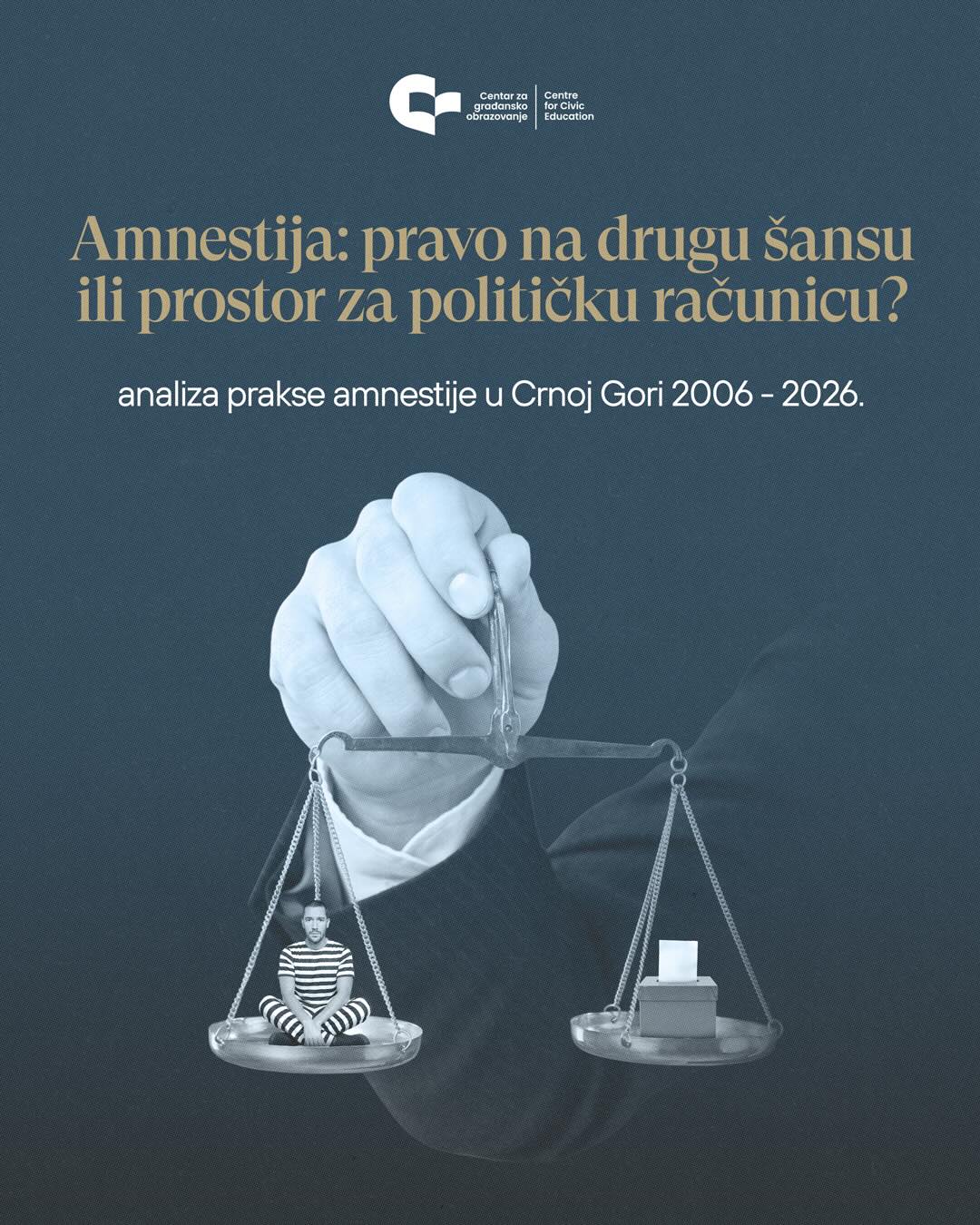
Since restoring its independence, Montenegro has adopted six amnesty laws, with each of them enacted between 45 and 130 days before or after the relevant elections. This proximity alone does not constitute evidence of political instrumentalisation, but its recurrence with every amnesty law, in a system that grants lawmakers broad discretion without sufficiently strong oversight mechanisms, represents a pattern that warrants particular attention, according to the findings of the Centre for Civic Education’s (CCE) publication „Amnesty: The Right to a Second Chance or a Space for Political Calculations? - An Analysis of Amnesty Practices in Montenegro 2006–2026“ by Rozana Vuljaj.
The analysis shows that access to amnesty has become more restrictive over the past two decades. The laws adopted in 2006, 2008 and 2013 provided for a 25 per cent reduction in sentences, while the 2010 law provided for a 20 per cent reduction. In 2020, differentiated reductions of 15, 10 and 5 per cent were introduced. At the same time, the range of criminal offences excluded from amnesty was expanded, while the possibility of benefiting from amnesty repeatedly was restricted.
- The key issue, however, is not only how much a sentence is reduced, but how broad the scope for deciding who can benefit from amnesty and under what conditions is. Montenegro’s legal framework does not establish clear substantive criteria for granting amnesty, nor does it provide specific procedural safeguards or require a mandatory prior expert assessment and subsequent evaluation of its effects. The study also shows that there is no obligation to obtain the prior opinion of judicial institutions on the justification, scope and possible consequences of an amnesty - said Milica Borozan, a project assistant at CCE.
She stressed that it is particularly concerning that, even after six amnesty laws, the state still does not have a unified and reliable record of their implementation. The Ministry of Justice does not maintain a dedicated register, while the data collected by CCE from the courts are neither consolidated nor complete or mutually consistent. As a result, Borozan said, it is impossible to reliably determine the total number of beneficiaries, the types of criminal offences involved or the longer-term effects of amnesties.
- In addition, available data show that amnesties have not applied only to people convicted of less serious offences. Recorded cases include people convicted of murder, robbery, aggravated theft, violent behaviour and unlawful possession of weapons, as well as abuse of office, accepting and giving bribes, embezzlement and abuse of position in business operations. Therefore, the scope of an amnesty cannot be assessed solely on the basis of the percentage by which sentences are reduced, but also in relation to the nature and seriousness of the offences for which beneficiaries were convicted - she added.
She also highlighted the relationship between amnesties and electoral cycles. The 2006 law was adopted 45 days before the parliamentary elections, while the 2020 law was adopted 66 days before the parliamentary elections.
- Nevertheless, some of the six laws analysed had compelling justifications. The 2012 law applied exclusively to insult and defamation following their decriminalisation, while the 2020 law was adopted under the extraordinary circumstances of the COVID-19 pandemic and justified by the need to reduce epidemiological risks within the prison system. Therefore, the proximity of elections must be considered together with the reasons for adopting each law and other weaknesses in the system, rather than in isolation - Borozan said.
She noted that the current 2026 proposal raises a different issue. The key justification cited for a new amnesty is the chronic overcrowding of the prison system.
- Unlike in 2020, when there was a temporary epidemiological risk, a one-off instrument is now being used to address a structural problem. Amnesty may temporarily reduce the number of people in the prison system, but it does not address the causes of overcrowding, which require adequate prison capacity, more effective use of alternative sanctions and more restrictive use of pre-trial detention - Borozan added.
According to her, comparative experiences from Croatia, Germany, Spain and France show that there is no single European model of amnesty, but also that broad discretion can be limited through a clearly defined purpose, precise temporal and substantive boundaries, predetermined exclusions, additional institutional checks and compliance with international standards.
- Croatia linked amnesty to a clearly defined historical objective and a time-limited scope; Germany combined precise substantive restrictions with extensive parliamentary debate and additional institutional checks; the Spanish model highlights the importance of aligning amnesty with international human rights standards, while France provides an example of prior expert and legal scrutiny alongside a broad range of exclusions. Compared with these solutions, Montenegro’s framework leaves relatively broad room for the reasons, scope and limits of amnesty to be determined on a case-by-case basis. The broader the discretion, the stronger the safeguards against arbitrariness must be - Borozan stressed.
Therefore, the Centre for Civic Education recommends establishing clearer criteria and restrictions for future amnesties, higher standards for providing justification and mandatory prior expert assessment, as well as more precise definitions of the criminal offences that cannot be covered by amnesty.
According to Borozan, it is also necessary to limit repeated use of amnesty, regulate the position of repeat offenders more precisely, establish a unified register of beneficiaries and introduce mandatory subsequent evaluation of the effects of each amnesty.
- When an amnesty is proposed close to elections, additional transparency and sufficient time for expert and public debate are essential. Amnesty has a legitimate place in the criminal justice system, but precisely because it intervenes in the consequences of final court decisions, it must remain an exception rather than an instrument whose boundaries are repeatedly redefined without clear criteria and reliable data. The right to a second chance must not become a space for arbitrariness or political calculations - Borozan concluded.