




Dizdarević: The security sector is compromised, NATO views us with caution due to suspicions of leaks of classified information

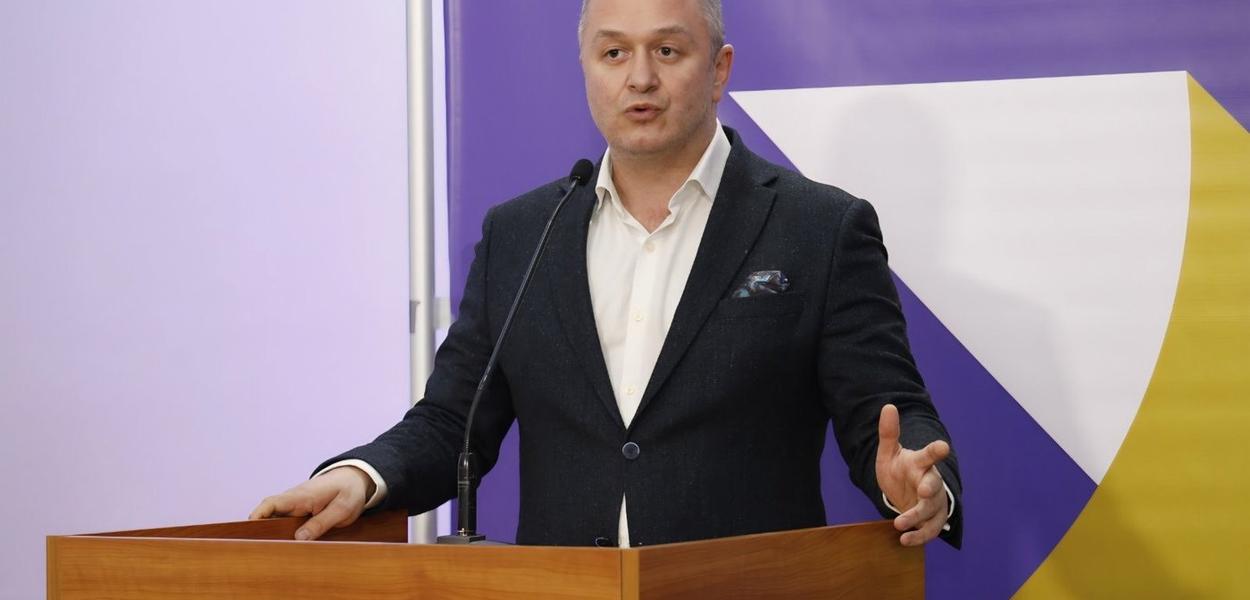
Vice President of the Democratic Party of Socialists (DPS) and Member of the Parliament of Montenegro Abaz Dizdarević speaks to Portal ETV about European integration, identity issues, the security situation, pressure on the media, and possible political outcomes ahead of key years for Montenegro’s future. Dizdarević warns that the current government is systematically slowing down the EU accession process, deepening social divisions, and endangering the stability of the state.
European integration under the current government
Portal ETV: As the opposition, how does DPS assess the pace and direction of European integration under the current government?
DIZDAREVIĆ: DPS has consistently assessed that the pace and direction of European integration have been significantly slowed compared to the widely open doors and the momentum set by the EU.
The lack of political will to implement key reforms, along with the ongoing postponement of appointing holders of key judicial positions (Judicial Council, Prosecutorial Council, Constitutional Court), means that decisions are not made in a timely manner. The absence of consensus within the ruling majority and the complete lack of communication with the opposition further slow down decision-making. At the same time, there is a constant introduction of issues that are not on the EU agenda, such as revising the Citizenship Law or identity-related issues, which divert attention from the EU path.
All of these topics undermine Montenegro’s foreign policy position, with an obvious intention to halt our country on its path toward EU membership.
Who in power does not want Montenegro in the EU
Portal ETV: Do you believe that within the current government there are those who will do everything to prevent Montenegro from becoming an EU member? If so, who are they?
DIZDAREVIĆ: Within the Government and the parliamentary majority there are political structures whose goal is not Montenegro’s full EU membership, but rather tying the country to the interests of other centers of power (Belgrade and Moscow).
These actors on our political scene strategically slow down reforms and insist on topics that are contrary to secular, civic, and Euro-Atlantic values.
Do you think it is necessary to list them by name? The public in Montenegro has, over the past decades, been able to see which structures have blocked the progress of Montenegrin society, so I do not believe it is necessary to underline who we are referring to.
Serbian language as an official language - a political agenda that threatens sovereignty
Portal ETV: Some political actors, specifically For the Future of Montenegro (Za budućnost Crne Gore) and Socialist People's Party (Socijalistička narodna partija), advocate introducing the Serbian language as an official language. What lies behind this initiative and what is its intention?
DIZDAREVIĆ: It is clear that this initiative is politically motivated and that it conceals an intention to dismantle Montenegro’s civic and identity fabric. It is an attempt to carry out cultural and linguistic assimilation, which is only one step toward the de-sovereignization of Montenegro, where Montenegrin identity, language, and culture would be denied.
We know that such issues are well protected by the Constitution of Montenegro and that, after a two-thirds majority in Parliament, a referendum must be organized in which three-fifths of all registered voters must vote in favor of the initiative in order to verify constitutional amendments. When this procedure is carried out, good luck to all parties involved in the process.
At the same time, it is clear that opening artificial identity issues at a moment when the focus should be on EU integration serves solely to obstruct our path toward the EU.
The chapel on Lovćen - a political provocation
Portal ETV: The issue of building a chapel on Lovćen has once again been raised by Andrija Mandić, For the Future of Montenegro (ZBCG), and the Serbian Orthodox Church. Is this an issue that could truly undermine peace and stability in Montenegro?
DIZDAREVIĆ: Our position is well known: this issue is closed, and any attempt to reopen it is a direct provocation and an effort to undermine civic peace and stability.
The Mausoleum of Njegoš on Lovćen is viewed as a symbol of modern and sovereign Montenegro.
Reactivating the chapel issue serves to deepen divisions within Montenegrin society and represents a political tool used to maintain tensions.
Undermining Montenegrin identity
Portal ETV: Is the current government systematically working to undermine Montenegrin identity?
DIZDAREVIĆ: Yes. Through its cultural policies, the Government is systematically working to marginalize Montenegro’s historical and cultural heritage. The rich history of our country is under attack by falsifiers of facts, while institutional protection of cultural heritage seems almost nonexistent.
Information disseminated through digital platforms such as Wikipedia forms the basis of education for young people who acquire knowledge online. At first glance, it is evident that falsifications aim to attribute the majority of Montenegro’s cultural heritage to other cultures.
In this important media field, Montenegro is clearly losing the battle, while state institutions are doing nothing to protect national identity. The situation is similar regarding the protection of cultural and historical monuments, creating the impression that what is most valuable in terms of identity is being systematically neglected and dismantled.
Deteriorating security situation
Portal ETV: How do you assess the current security situation in Montenegro under the present government?
DIZDAREVIĆ: The security situation has significantly deteriorated over the past few years. The outflow of professionals or politically motivated purges of professionals from the police and the National Security Agency have placed us in a position where our international partners - eespecially NATO - have begun to view us with caution due to suspicions of leaks of classified information and the compromise of security services.
Selective justice in the security sector
Portal ETV: Does the security sector led by the Democrats implement selective justice?
DIZDAREVIĆ: We often point out that the fight against crime and corruption is politically motivated and selective. The focus is exclusively on prosecuting former officials, while illegal actions by the current government and its coalition partners are continuously tolerated.
We are inclined to demonstrate through concrete examples that justice is being used as a political tool to settle scores with dissidents, rather than as a genuine fight against all forms of crime. Due to countless examples of selectivity, we cannot trust the good intentions of the overall security system.
Pressure on the media and journalists
Portal ETV: Do you notice pressure and threats, especially toward journalists and the media?
DIZDAREVIĆ: DPS has repeatedly pointed out that there are political pressures on the media and journalists, particularly those who are critical of the current government.
These pressures are evident through political smear campaigns against officials in media outlets close to the Government and through the misuse of the public broadcaster RTCG for the needs of the ruling majority.
This is also clearly seen in the employment of politically loyal individuals within the public service broadcaster (RTCG), which undermines objectivity and public trust in a service meant for all citizens.
Reconstruction of the government and the role of DPS
Portal ETV: Do you believe there will be a reconstruction of the government to accelerate Montenegro’s path toward the EU? What role do DPS and the opposition have in that process?
DIZDAREVIĆ: We believe that any reconstruction is unsustainable if it includes parties that are ideologically opposed to the EU path - clearly referring to For the Future of Montenegro, which in past decades openly pursued destructive policies regarding EU integration.
We emphasize that the only sustainable solution is the formation of a government that would return Montenegro to the track of a civic state and prepare the ground for elections.
We are confident that we can offer a stable, pro-European alternative to the current government, which is burdened by internal tensions and disagreements over fundamental values. The question is whether there is sufficient understanding for such ideas, which are the only guarantee of success on the fragile path of European integration.
Challenges facing Montenegro in 2026
Portal ETV: What are the biggest challenges Montenegro will face in 2026?
DIZDAREVIĆ: The biggest challenges are definitely economic in nature. The economic crisis we are experiencing is a consequence of increased public debt, creating uncertainty in budget financing, which is clearly reflected in declining living standards.
Second, we are entering a serious phase of political instability, with growing instability within the current Government, which inevitably leads to the blockage of key reforms on the EU path.
Third, as we get closer to the European dream, identity divisions will grow correspondingly, as further polarization of society depends on the imposition of artificial topics that may also become stumbling blocks on the EU path.
It is also important to mention the security risk of further compromising the security sector and endangering partnerships with NATO and the West. All of these risks will complicate the overall situation in 2026.
A sovereignist and pro-European bloc ahead of the 2027 elections
Portal ETV: Will there be the creation of a sovereignist and pro-European bloc that will act jointly during the crucial period for EU accession, ahead of the 2027 elections?
DIZDAREVIĆ: The creation of a broad sovereignist, civic, and pro-European bloc that could deliver the desired outcome in the upcoming elections may be one of the solutions for confronting the regressive policies implemented over the past six years. It is important to find a reliable model to strengthen the opposition force that will protect Montenegrin identity and the secular, antifascist character of the state.
The task of such a structure is to further accelerate the EU path and put an end to the erosion of institutions. We will consider the best options and adequately prepare for the challenges that await us in 2027.