




Gorčević: France and Germany are two key countries for enlargement policy; Krichbaum: I believe Montenegro can close the remaining chapters by the end of the year

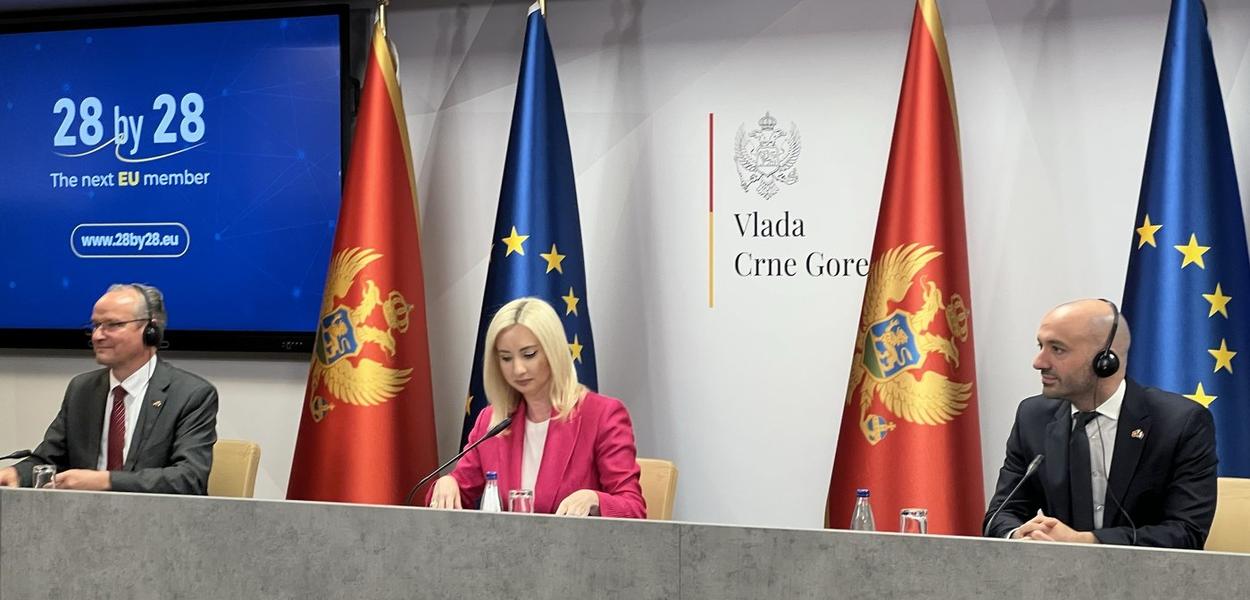
France and Germany are two key countries when it comes to the European Union’s enlargement policy and two crucial countries when discussing Montenegro’s future within the EU, Minister of European Affairs Maida Gorčević said at a press conference on the finalisation of Montenegro’s EU accession process.
She stressed that it is important for Montenegro to be recognised as a reliable partner and as a country capable of contributing to regional cooperation on a range of issues. According to Gorčević, Montenegro’s focus remains on reforms, the rule of law, and closing the remaining negotiation chapters by the end of the year in order to achieve its strategic goal - full EU membership by 2028.
- We welcome the establishment of the ad hoc working group tasked with drafting the Accession Treaty. In the coming months, we will have more information, but this process requires the support of all EU member states, as well as stronger communication efforts by Montenegro, so that we can build a successful enlargement story - Gorčević said.
Minister of State for Europe at the Federal Foreign Office of Germany, Gunther Krichbaum, stated that Montenegro is leading the EU integration process among the six Western Balkan countries.
He believes that the final conditions for closing the negotiation process can be met by the end of the year, but added that this depends both on Montenegro and on all political actors involved.
- This is not only the Government’s responsibility; it is also the responsibility of the opposition. We all need to do this for future generations. We are building a united Europe for our children - Krichbaum said.
Speaking about the broader geopolitical context, he praised Montenegro’s engagement, particularly while chairing the Berlin Process.
- This is not only important for Montenegro itself but for the entire region. It is intended to contribute to regional stability - Krichbaum stressed.
Responding to a question about a letter from German Chancellor Friedrich Merz, in which he called for accelerating the EU enlargement process and proposed special forms of membership for candidate countries, Kribaum said that „the final destination is full membership“, while noting that accession negotiations with the EU often take a very long time.
He explained that Merz’s proposal relates to the EU’s enlargement methodology. He recalled that Croatia negotiated for eight years before joining the Union and warned that people tend to lose patience during lengthy accession processes.
- Montenegro, Serbia, and Albania have been negotiating for a very long time. We must also consider the perspective of citizens - Krichbaum said.
He explained that countries could be granted observer status depending on the progress they achieve in negotiations. According to Krichbaum, Merz’s proposal is essentially a message to aspiring member states that they are already part of the broader European project. It is also a message that must be conveyed to citizens so that they do not lose hope, as well as a signal to Russia and China that these countries belong within the European Union.
- We cannot continue as we have in the past. Montenegro is almost ready for membership. I believe that by the end of the year it can complete the chapter-closing process, after which the Accession Treaty could be signed and ratified. However, there are countries that still have a long road ahead of them, and we must offer them a credible perspective. If we fail to do so, we ourselves will lose credibility - Krichbaum said.
Benjamin Haddad, France’s Minister Delegate for Europe, reiterated French President Emmanuel Macron’s support for Montenegro’s European path.
- We live in a time of geopolitical rivalries. We see Russia’s aggression against Ukraine, and at times pressure from the United States on the European Union. At the same time, we see countries that are genuinely committed to joining the EU because they understand that membership means a better future for their citizens. We still have much work to do to reform the European Union, but when we look at the determination of countries such as Montenegro to join us, it shows that the EU has promising days ahead - Haddad concluded.