




Human Rights Action: No justice for the Klapuh family 34 years after the crime, Kovač and Vuković must be brought before a court in Bosnia and Herzegovina

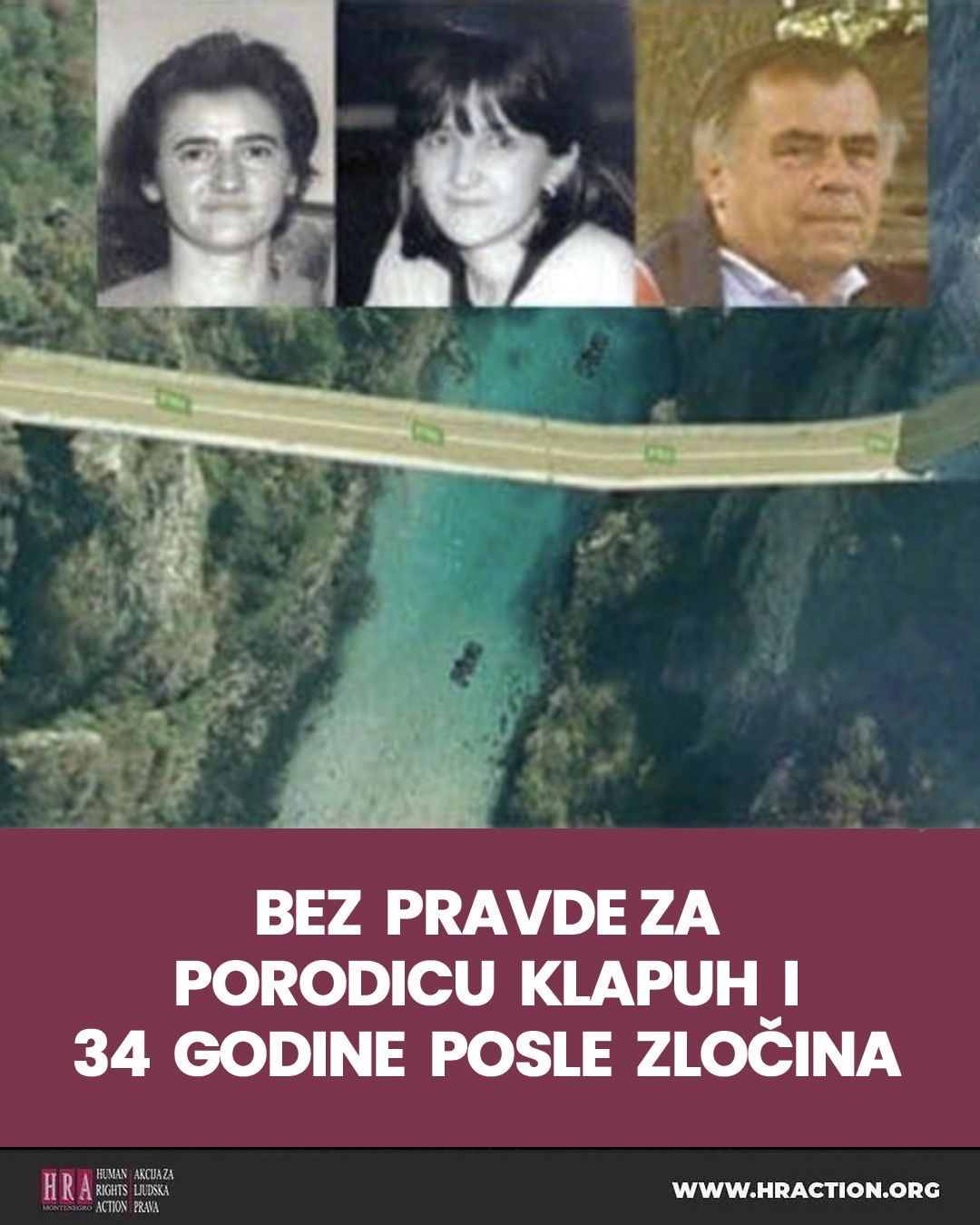
Thirty-four years after the murder of the Klapuh family, Radomir Kovač and Zoran Vuković, who were convicted in 1996 for the crime committed on the territory of Montenegro during the 1992 war, have still not been held accountable - the NGO Human Rights Action (HRA) said.
According to HRA, Montenegro has fulfilled its obligations with regard to criminal accountability, and it is now up to Bosnia and Herzegovina to ensure justice.
- We warn of the risk of the de facto amnesty of the perpetrators of this war crime - the organization said in a statement.
HRA recalled that Hasan Klapuh, his wife Ferida and their daughter Sena were murdered near the Montenegrin town of Plužine in 1992, during the war in Bosnia and Herzegovina, by four members of the „Dragan Nikolić“ unit of the Army of Republika Srpska. The perpetrators had agreed, in exchange for payment, to transport the Foča family safely from Bosnia and Herzegovina into Montenegro. The court later established that, after crossing the border, they stopped near the Mratinje Dam on the Piva River, forced the family out of the vehicle, shot them, and threw their bodies from a bridge approximately 100 metres high.
- In one of the region's earliest war crimes trials related to the conflicts of the 1990s, Montenegro's courts in 1996 convicted Janko Janjić, Radomir Kovač, Zoran Simović and Zoran Vuković of the war crime against the civilian population committed against the Klapuh family, sentencing each to 20 years' imprisonment. A fifth defendant, Vidoje Golubović, was sentenced to eight months in prison for failing to report the crime and its perpetrators. Golubović was the only one to serve his sentence. The remaining defendants were tried in absentia because they were fugitives, and none of them has spent a single day in prison for this crime. While two of the convicted men have since died, Radomir Kovač and Zoran Vuković continue to live freely in Bosnia and Herzegovina - the statement said.
Ahead of the 34th anniversary of the killings, the Prosecutor's Office of Bosnia and Herzegovina informed Ferid Klapuh, the sole surviving member of the family, that it did not intend to prosecute Kovač and Vuković, despite their conviction in Montenegro and their current residence in Bosnia and Herzegovina.
- Bosnia and Herzegovina had previously rejected Montenegro's request to allow the convicted men to serve their prison sentences there. Montenegro subsequently transferred the complete case file from the final criminal proceedings to the Bosnian authorities so that a new trial could be conducted. However, the Prosecutor's Office of Bosnia and Herzegovina now claims that it cannot prosecute individuals who were tried in absentia in another country once they return home. Human Rights Action warns that this position has no basis in either domestic or international law and creates a deeply troubling model of impunity, even for the gravest criminal offences, Effectively rewarding citizens of Bosnia and Herzegovina who manage to flee the country where they committed serious crimes – Human Rights Action highlights.
The Bosnian prosecution argues that the matter has already been adjudicated and therefore cannot be prosecuted again under the principle of ne bis in idem, even though Kovač and Vuković were convicted in Montenegro and have never served the sentences imposed by that judgment.
- However, there are no legal obstacles to prosecuting them in Bosnia and Herzegovina. Article 8 of the European Convention on the Transfer of Proceedings in Criminal Matters expressly allows Bosnia and Herzegovina to take over the proceedings and retry the defendants. A retrial in Bosnia and Herzegovina is the only way they can be brought to justice, since they cannot serve prison sentences imposed following trials in absentia in Montenegro, while Bosnia and Herzegovina neither extradites its nationals convicted of war crimes nor enforces such judgments – the statement reads.
HRA noted that the same conclusion was reached by Bosnian legal experts Amir Čengić and Lejla Terzimehić in their paper Ne Bis in Idem in the Context of Concurrent International Jurisdictions. Although their legal opinion was submitted to the Prosecutor's Office, it received no substantive response. Instead, Ferid Klapuh was simply informed, without explanation, that the murder of his family could not be prosecuted again.
- The remains of Ferida and Sena Klapuh have been recovered and identified, while DNA analysis is still pending to confirm the identity of Hasan Klapuh following the re-exhumation of remains from an improvised burial site near the tennis courts in Nikšić. Bosnia and Herzegovina has an obligation to prosecute Kovač and Vuković because their participation in the crime has already been established through evidence contained in the case file transferred by Montenegro. Abandoning prosecution amounts to a de facto amnesty for the perpetrators - an institutional endorsement of impunity for a war crime committed against civilians – HRA stresses.
Human Rights Action called on the Prosecutor's Office of Bosnia and Herzegovina to urgently reconsider its decision, assume jurisdiction over the criminal prosecution, and ensure that Radomir Kovač and Zoran Vuković are brought before a court in Bosnia and Herzegovina so that, after 34 years, justice may finally be served, at least in part.