




The Radio Television of Montenegro has no right to remain silent about the censorship of Mićanović’s speech
This is a telling example of the Public Broadcaster’s editorial (in)dependence and its (in)ability to act as a watchdog over those in power precisely when doing so is uncomfortable for the authorities. A public broadcaster that selects topics based on how politically inconvenient they are is not a service to citizens, but a service to the political comfort of those in power. Therefore, alongside the question of who prevented Mićanović from delivering his speech and why, an equally important question arises: who at the Radio Television of Montenegro decided, and why, that the citizens of Montenegro should not be informed about it?

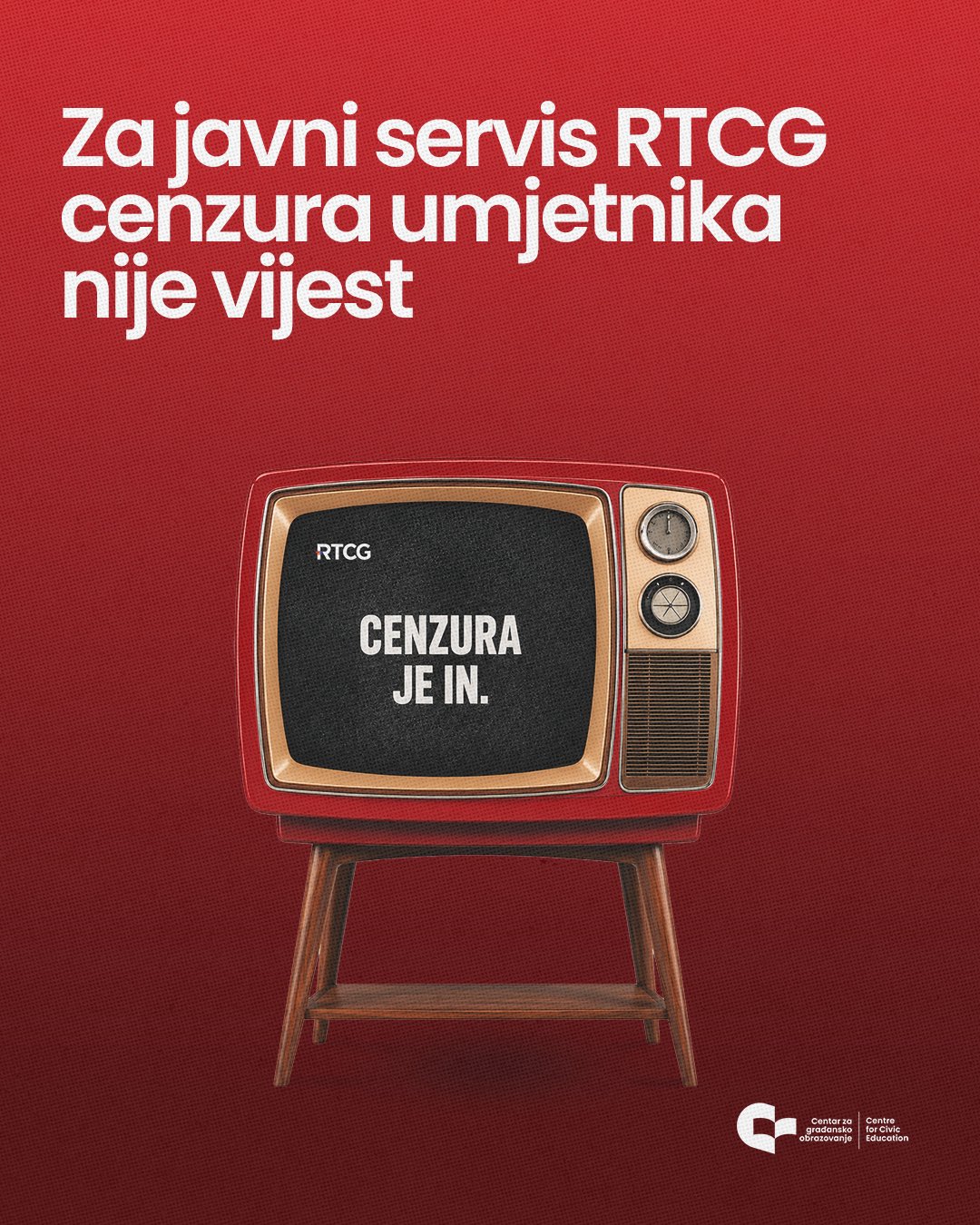
Almost all relevant media outlets in Montenegro, as well as numerous media outlets across the region, reported on the case involving actor Dragan Mićanović. The Radio Television of Montenegro chose to remain silent about it in its main news programmes and on its website. Yet the public service has no right to such silence, the Centre for Civic Education said.
Mićanović, who was scheduled to open the 39th Herceg Novi Film Festival, was prevented from reading his prepared speech, in which he criticised violence in Serbia and defended freedom of artistic expression.
The Centre for Civic Education reminds that the Public Broadcaster is not a private media outlet whose editorial policy is dictated by particular interests.
Rather, it is a public service funded by citizens and legally obliged to provide them with impartial and comprehensive information on matters of public interest, the organisation said.
- If an artist is denied the opportunity to speak at one of the country’s most significant cultural events because of the content of his speech, and if the Ministry of Culture and Media is behind such a decision, then this is a matter of public interest by any professional definition of news. When a public service omits such information, that is not neutrality but an editorial choice. And that choice benefits those whose conduct should be critically scrutinised, rather than the public to whom the Radio Television of Montenegro is legally accountable – they said in a statement.
It is particularly absurd, they stressed, that a discussion about the political censorship of an artist is met with political (self-)censorship precisely at the public broadcaster.
- This is a telling example of the Public Broadcaster’s editorial (in)dependence and its (in)ability to act as a watchdog over those in power precisely when doing so is uncomfortable for the authorities. A public service that selects topics based on how politically inconvenient they are is not a service to citizens, but a service to the political comfort of those in power. Therefore, alongside the question of who prevented Mićanović from delivering his speech and why, an equally important question arises: who at the Radio Television of Montenegro decided, and why, that the citizens of Montenegro should not be informed about it – the Centre for Civic Education said.
According to the organisation’s statement, the Public Broadcaster’s silence on the censorship further reinforces the practice of restricting freedom of expression, which is directly contrary to the mission of a public service broadcaster.