




Đukanović: I am on my feet because I knew what was coming, and until my last breath, I will fight for the values to which I have devoted my life

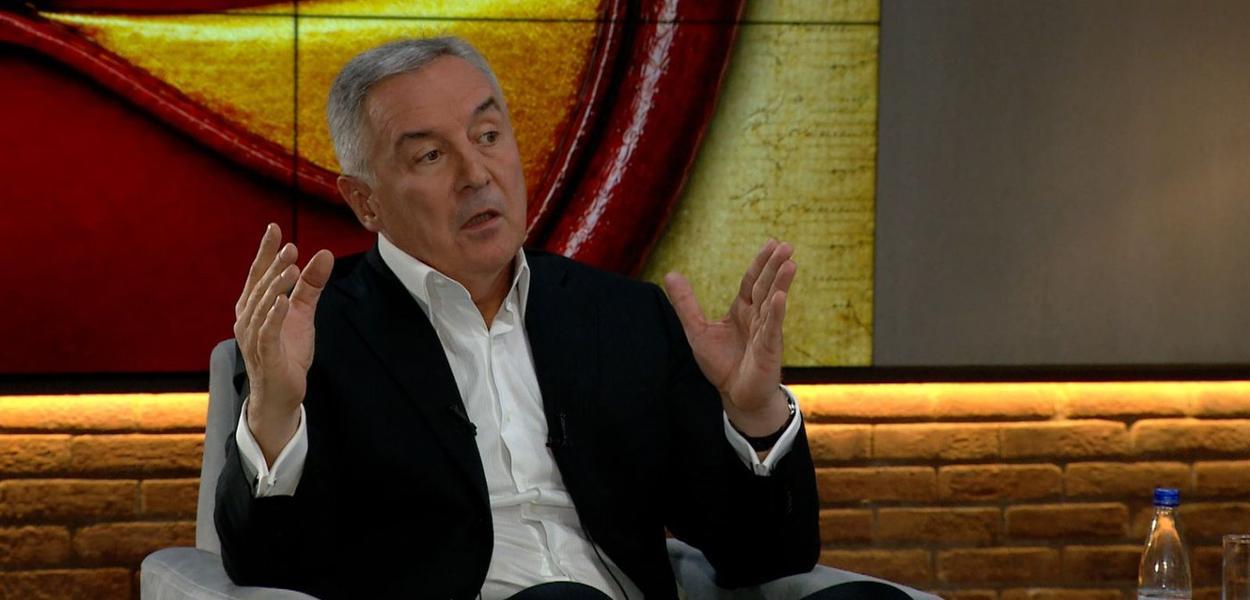
I am on my feet because I was aware of what would happen after the change of government in 2020, and because I am not inclined to kneel. On the contrary, I am inclined to fight until my last breath for the values to which I have devoted my life, said former President of Montenegro Milo Đukanović, the long-serving Prime Minister and leader of the Democratic Party of Socialists, and honorary president of the DPS, in a lengthy interview with Television E on the occasion of the 20th anniversary of the restoration of Montenegro’s independence.
In the final part of the program „Trag u vremenu” (“A Trace in Time”), Đukanović spoke about the period of restoring independence, economic progress, and Euro-Atlantic integration… In that context, he recalled the political and economic moves which, according to him, paved the way for the restoration of Montenegro’s independence, as well as the developments in the country after May 21, 2006.
As the key points of his political legacy, Đukanović highlighted the referendum restoration of independence, the introduction of the Deutsche Mark, membership in NATO, and resistance to what he claims were external attempts to destabilize Montenegro.
Introduction of the Deutsche Mark
The introduction of the Deutsche Mark into Montenegro’s payment system was perhaps, according to Đukanović, the most significant step Montenegro took in preparing to decide on independence. He recalls that Yugoslavia was the world record holder for inflation in the period immediately preceding it. The scale of the inflation is illustrated by the fact that a 500-billion-dinar banknote was printed.
- Completely uncontrolled money printing in Belgrade, inflation was created that simply spilled over into Montenegro. The pension received by a Montenegrin pensioner was not worth the same at eight o’clock and at nine o’clock in the morning. Therefore, it was necessary to make a move that would protect Montenegro’s economic interests and the already endangered standard of living of Montenegrin citizens - said Đukanović.
Đukanović states that the government opted for the introduction of the Deutsche Mark because it was already functioning as a reserve payment in Montenegro.
He notes that resistance to the idea was strong, even from the highest international circles. They clearly recognized, he says, that the possible introduction of the Deutsche Mark would further strengthen the idea of Montenegro’s independence.
- I remember my telephone conversation with United States Secretary of State Madeleine Albright before I visited Washington. She used all of her authority and unquestionable friendship toward both Montenegro and me to convince me not to do it. In the end, she said: „Well then, wait until you come to Washington, and perhaps do it afterward.“ I said: „No, everything is already prepared, we will introduce the Mark first, and then I will come to Washington“ - Đukanović revealed.
„Đukanović–Madeleine Albright: Wait until you come to Washington, and then perhaps introduce the Mark. I said no, first we will introduce the Mark, and then I will come to Washington“
He recalls conversations on the subject with the Italian Foreign Minister, Lamberto Dini, and the German Foreign Minister, Joschka Fischer. They were categorically opposed to the introduction of the Mark, he says. According to his interpretation, a hint of a unified position of reservation toward the idea of Montenegrin independence.
- Thanks to our unwavering stance, Montenegro remained within the euro system after the introduction of the Mark at the end of 1999, and it remained so when the euro replaced European national currencies in mid-2002. I believe that this was truly an exceptionally important step. The benefits of the Mark and the euro were also felt by foreign investors, who came to Montenegro’s investment environment with greater confidence. However, I believe that it was above all a relief for the citizens of Montenegro, because after a long period of social suffering during times of severe inflation, they finally began using convertible currency - Đukanović added.
Uncertainty until the last ballot box
As he says, he was not convinced of the outcome of the referendum. He emphasizes that he knew the referendum result would be close and that uncertainty will last until the counting of the very last ballot box.
Nevertheless, Đukanović notes that he knew there was no valid alternative to that path and no possibility of creating a functional union between such disproportionate entities as Serbia and Montenegro.
- Two key differences did not allow sustainable harmonization between Serbia and Montenegro to be achieved in a short period of time. On the economic level, all attempts to harmonize the customs systems of Serbia and Montenegro in the period after the signing of the Belgrade Agreement were absolutely unsuccessful, due to irreconcilable differences in the structures of our economic systems. On the political level - the ruling ideology in Serbia for a long time was Greater Serbian nationalism. In contrast, Montenegro is a civic and multiethnic state. An open society which, long before the referendum, already showed interest in becoming an integral part of European Euro-Atlantic integration - Đukanović explained.
Perhaps, as he states, Serbia may one day also become a member of the EU, but his belief, based on his knowledge of that society, is that even then it would not be the result of a sincere desire to become part of the system of European values.
Đukanović emphasizes that all societies in the Western Balkans are similar to one another, but also asks: „When you have such societies, and when you have such a tradition and reputation, what is then crucially important?”
- Crucially important is leadership. You cannot expect that, without good leadership, people who are xenophobic, reluctant toward any kind of experiment or anything unfamiliar, and who throughout history mostly looked toward the East and toward Russia, suddenly support Western integration. Someone has to propose it, promote it, persistently and convincingly advocate for it - he emphasized.
„Unjust, but necessary 55 percent”
Đukanović reiterates that the European Union was necessary for Montenegro as a partner and that without recognition from that address, the referendum would not have sufficient weight.
- The required majority of 55 percent was unjust. But I understood the EU’s reasoning. The EU’s fresh experience with an unstable Balkans, from the wars of the early 1990s and the war with NATO, led it to doubt the democratic capacity of Western Balkan societies to resolve such major issues, such as the question of state status, through democratic procedures and under conditions of stability. Additionally, the EU knew that opponents of independence had strong support from Belgrade and suspected that this could lead to instability after the referendum. Following earlier experience, they expected to be called upon to resolve that problem - Đukanović explained.
„You cannot expect that without strong state-political leadership, people who are reluctant toward anything unfamiliar, who throughout history have mostly looked toward the East and toward Russia, suddenly support Western integration. Someone has to persistently and convincingly advocate for that“
Due to the acceptance of such a majority, he notes, pro-independence supporters faced dissatisfaction.
- I understood such emotions as well, but I knew it was not rational. We needed the EU to have an internationally legitimized referendum and thereby take away from the opposition the arguments it wanted, with boycott, to use to render the democratic referendum meaningless - Đukanović explained.
Independent Montenegro - a reliable investment destination
After the restoration of independence, one of the government’s key tasks, says Đukanović, was to attract high-quality partners who would help the country’s economic development.
- It was clear that Montenegro needed foreign direct investment, serious partners, not only because of capital, but also because of new standards, knowledge, and skills - he added.
With that goal, he explains, an attractive tax policy was created, with a corporate profit tax rate of nine percent, which was by far the lowest in the region and perhaps in Europe. This, he emphasizes, led to significant interest from capital owners.
- In that period, investments such as Porto Montenegro, Luštica Bay, and Porto Novi were launched and developed. The undersea cable project to Italy also began. An investor was selected for the start of highway construction, along with many other investments. Investment offers were vast and diverse, we even had proposals to build a new Formula 1 racing track, as well as tourist complexes in Velika Plaža and Buljarica… Many good and high-quality proposals came in, and at the same time, we had to be careful about the rational use of space and the protection of Montenegro’s environment. I believe we managed that quite skillfully. That was a period of serious economic prosperity - Đukanović emphasized.
Split in the DPS–SDP coalition
Another decision, Montenegro’s accession to NATO, caused significant political turbulence. The goal of the protests held by the Democratic Front (DF) in front of Parliament was to stop Montenegro on that path.
When asked whether the first signs of a split within the ruling coalition began at that time, Đukanović says there were misunderstandings within the governing coalition even earlier, but that they were significantly intensified during that period.
He recalls that several years before Montenegro decided to join NATO, Putin stated at the Munich Security Conference that Russia strongly opposed NATO’s expansion to its borders and to countries it considered friendly. This referred to Balkan states, primarily Montenegro and Serbia.
- The idea of stopping NATO enlargement inspired the protests in front of Parliament - Đukanović said.
However, he also notes that there was a problem of careerist overambition that „gave birth“ within the ranks of the SDP as a coalition partner. The party’s parliamentary group of four members, Đukanović says, acted against most Government proposals, even they were part of that government.
- Information was multiplying, coming from a very recognizable media and political center in Montenegro. It was announced that the government was about to fall, that the SDP would leave the government, and that Krivokapić, as SDP leader, in agreement with the DF and other opposition, would be the new prime minister. In those centers of media and parapolitical power, it was important to bring down the DPS and Đukanović. I know for certain that this was not only media spin, but a serious political discussion. Despite that, I did not want to rush into any investigation, taking into account that our priority was to stabilize the extra-institutional disorder in front of Parliament, and only after that did I propose a vote of confidence in the Government - Đukanović emphasized.
He knew, he says, that the SDP will vote against the government. He did not have a clearly defined alternative support, but he did not want to continue living in such hypocrisy.
- After days of debate on the vote of confidence in the Government, support from Positive Montenegro emerged. The government survived, and the SDP went into opposition. The direct answer to whether that event undermined trust between the two traditional coalition partners and changed the balance of power on the Montenegrin political scene is yes. Four years later, Montenegro’s sovereign, civic, and pro-European policy received minority support, and the policy of the then opposition, dominated by Greater Serbian nationalism and clerical nationalism, secured a narrow majority - Đukanović said.
The verdict in the „Coup Attempt” case is a bad message to enemies
Đukanović states that he has zero dilemma that, around the 2016 parliamentary elections, there was a very serious operation aimed at destabilizing Montenegro, including a violent attempt to change the government, all to prevent Montenegro’s accession to NATO.
- We know that representatives of the Russian military intelligence agency GRU were in Belgrade and were directing the preparation of the coup from there. Also, several Russian oligarchs with significant amounts of money were involved, acting on the instructions of certain power centers in Moscow, to contribute to the electoral success of the pro-Serbian and pro-Russian opposition in Montenegro. Or to overthrow the government in the event of an unsatisfactory result - he said.
Despite all of that, the operation failed, according to Đukanović, primarily because its creators underestimated Montenegro.
- They believed they could carry out the operation with some second-rate operatives from Serbia whom they met on various Soviet battlefields. A half world driven mainly by financial interest, incapable of executing such a plan. They also lacked sufficient security culture and communicated in a way that was relatively easy to track. One of them, at a moment of remorse, came to the security center in Podgorica and revealed what was being prepared. The prosecution reacted in time and arrested those involved in the implementation of that malicious plan - Đukanović recalled.
An impossible mistake by influential services
He recalls that he personally reviewed documentation from the Serbian Security Information Agency (BIA), confirmed what Serbian President Aleksandar Vučić had stated the day before at a press conference.
- There was no dilemma that this involved the preparation of a violent change of government, which also included killings. Why did the authorities in Serbia, after initially announcing support for the judicial process in Montenegro, radically change their position? Because of a visit from Moscow, during which an influential guest shut their mouth on this issue. In 2018, as President of the state, I visited London and, in person, received an invitation to meet with the leadership of their very powerful intelligence service. The entire leadership was present, and the meeting was, in essence, an acknowledgment of Montenegro and its security services for the success in preventing the coup attempt. Similar findings were shared with us by other of the world’s most powerful intelligence agencies. It is unlikely that all of those powerful and influential services made such a major mistake - Đukanović stated.
„I believe that the court epilogue of the 2016 coup attempt sent an extremely bad message to all our enemies, that here they can indulge and do whatever they want with impunit“
He believes that such a judicial epilogue, which concluded this case, would not have been possible in any other country.
- We sent an extremely bad message to all our enemies that here they can indulge and do whatever they want with impunity, that there is no one to defend this country - emphasized Đukanović.
He emphasizes that judicial independence from other branches of government is assumed, but notes that all are jointly dependent on national interests.
- Because this state elected us, gave us trust, pays us, and it has no chance of surviving unless all of us, professionally engaged by it, work in its interest. I raise this sensitive topic very deliberately, because I believe that as a society we will have to address it very seriously in the near future - Đukanović concluded.
Loss of power in 2020
Đukanović also spoke about the impact of the litija on the 2020 election outcome.
- It is no surprise to me that Russia needed to pay us back for the failure four years earlier. Nor that Serbia recognized its opportunity in that. Finally, its Church was on the front line. It saw this opportunity as a realistic chance to achieve its traditional interests in relation to Montenegro. What surprised me, however, was the attitude of our Western partners toward those events, even though we regularly informed them, starting from the NATO Secretary General, about what the hybrid pressure from Moscow on Montenegro looked like - Đukanović said.
He recalls that many Western officials at the time spoke about insufficient understanding by Montenegrin state authorities of the rights of believers of the Serbian Orthodox Church.
- That was music to the ears of nationalists within the ranks of the SOC. Of course, I understood that in many Western capitals, there was even an openly expressed desire for a change of government in Montenegro, logically after 30 years of continuity. What I cannot understand is that they did not see what we saw from here, and what was completely obvious, that the main scenario of those events came from Moscow. Or they saw it, but gave priority to some of their other interests. Either way, Western diplomacy, starting with the American one, played the role of a „useful idiot“ for Russia and for Vladimir Vladimirovich Putin - he said.
„It is no surprise to me that Russia needed to pay us back for the failure four years earlier. Nor that Serbia recognized its opportunity in that. What surprised me was the attitude of our Western partners toward those events, even though we regularly informed them about what the hybrid pressure from Moscow on Montenegro looked like“
He adds that they came to their senses a year or two later and, through the European Parliament, stated that the Serbian Orthodox Church was an instrument of Russian imperialism in the Balkans.
- That is correct, but Montenegro has no benefit from their delayed truth. No one can wash away responsibility for misjudgments that cumulatively contributed to Montenegro experiencing such a change of government. Let’s be clear, I do not see the change of government as a tragedy, on the contrary. It would have been quite healing if circumstances were different. But instead of a serious civic and pro-European policy, the helm of the state ended up in the hands of various clerical nationalists, illusionists, populists, and incompetent people, and then we face very serious consequences - both in the state and in the associations we belong to - Đukanović pointed out.
Ready to confess everything without trial
Đukanović also says that he does not care much and that he is not disturbed by the announcements of various actions by the police and the prosecutor's office. He is ready, he says, to confess everything even without a trial.
- I admit responsibility for preventing war in Montenegro in the 1990s. I admit responsibility for the fact that Montenegro, for the first time in its history, achieved economic sustainability in 1994. I admit responsibility for the fact that Montenegro avoided NATO bombing. I admit responsibility for showing understanding for the preservation and improvement of good relations with Serbia as an important neighbor by signing the Belgrade Agreement together with Filip Vujanović. I admit that I, together with a large number of people in Montenegro, contributed to the restoration of Montenegrin independence, even if necessary, and that I led them into committing that „crime.“ I admit that after independence, I contributed to Montenegro becoming a member of NATO. I admit that I contributed to Montenegro receiving 11 billion in foreign direct investment. I admit that I contributed to Montenegro being on the threshold of the European Union, and finally, I admit that I am solely responsible for the fact that, even after six years of the persistent search by the new parliamentary majority for skeletons in the closets left behind by my government, there are none to be found. What else should I admit, and how else should I respond to what I have already long defined as a complex-driven revenge campaign characteristic of the new authorities? Instead of offering a new quality of politics to the Montenegrin public, they offer confrontation with the previous government. That is why today, unfortunately, we live in an atmosphere of lynching and revenge - said Milo Đukanović.
He added that in this impatience and futile spending of time, people are treated in an unacceptable, inhumane, and irresponsible way, with an obvious intention to inflict moral damage, while, as he claims, the broader campaign has resulted in one non-final verdict against the President of the Supreme Court.
- Time is the ultimate judge, ten more years will pass, and people in Montenegro will be able to judge more objectively what the government before 2020 did for them, and what this one did. I am on my feet because I knew what was coming and because I am not inclined to kneel. On the contrary, I am inclined to fight until my last breath for the values to which I have devoted my life,” concluded Đukanović in the program „A Trace in Time“ on Television E.