




Early retirement of police officers as a new „vetting“ mechanism
The announcement by the European Commission - that it will closely monitor the implementation of the Law on Internal Affairs, as well as the hiring and dismissal processes within the Police Directorate - has pushed the Democrats of Aleksa Bečić to quickly develop alternative solutions for purging the police of politically unsuitable officers. That is why a process of early retirement is now being initiated, but selectively


A rapid change in tactics to achieve the same goal - this roughly describes the new action of the Democrats led by Aleksa Bečić. The major media attention surrounding amendments to the Law on Internal Affairs and the Law on the National Security Agency forced Minister Danilo Šaranović and Police Directorate head Lazar Šćepanović, together with their advisors, to seek a new solution.
And an alternative was quickly found.
NEW ACTION, OLD GOALS
According to ETV information, the Democrats, following a proposal by Police Directorate Director Lazar Šćepanović, decided to send a number of police officers, largely those involved in disciplinary proceedings, into early retirement.
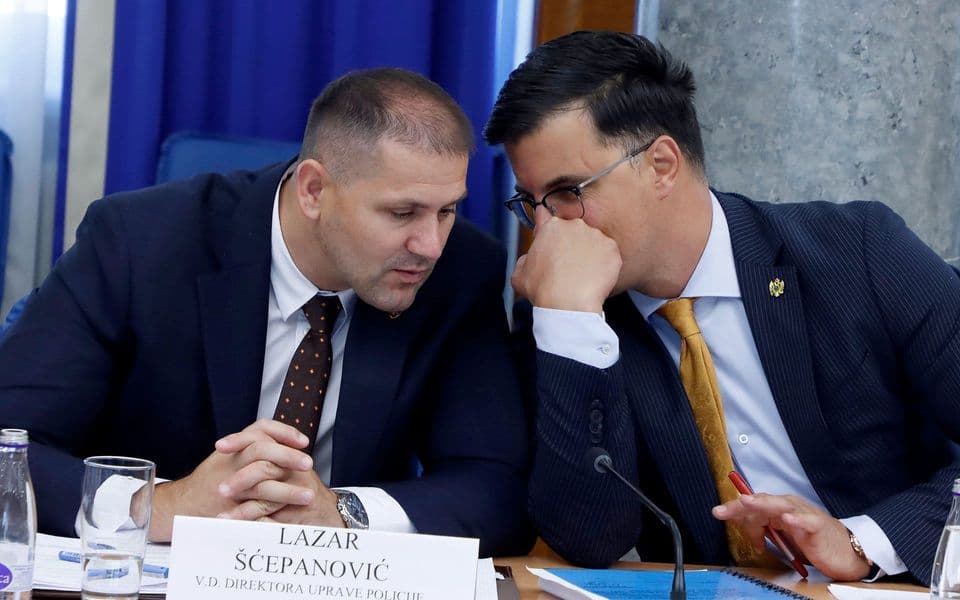
This action began at the end of last week, and it is estimated that most decisions will be delivered by the end of March.
Sources within the Police Directorate state that the Democrats opted for early retirement measures due to uncertainty over the implementation of the Law on Internal Affairs - as a kind of fallback mechanism to remove police officers who are not to the liking of Šaranović and Šćepanović.
It was precisely at the proposal of the Police Directorate Director that it was decided to send a significant number of police officers, those covered by the so-called vetting process and disciplinary proceedings, into retirement.
(MIS)USE OF THE LAW
According to information from the top of the Police Directorate, police officers, as well as former managers, all those at least 50 years old and against whom disciplinary proceedings are being conducted, are now being summoned to local security departments according to their place of residence to sign prepared requests for early retirement.
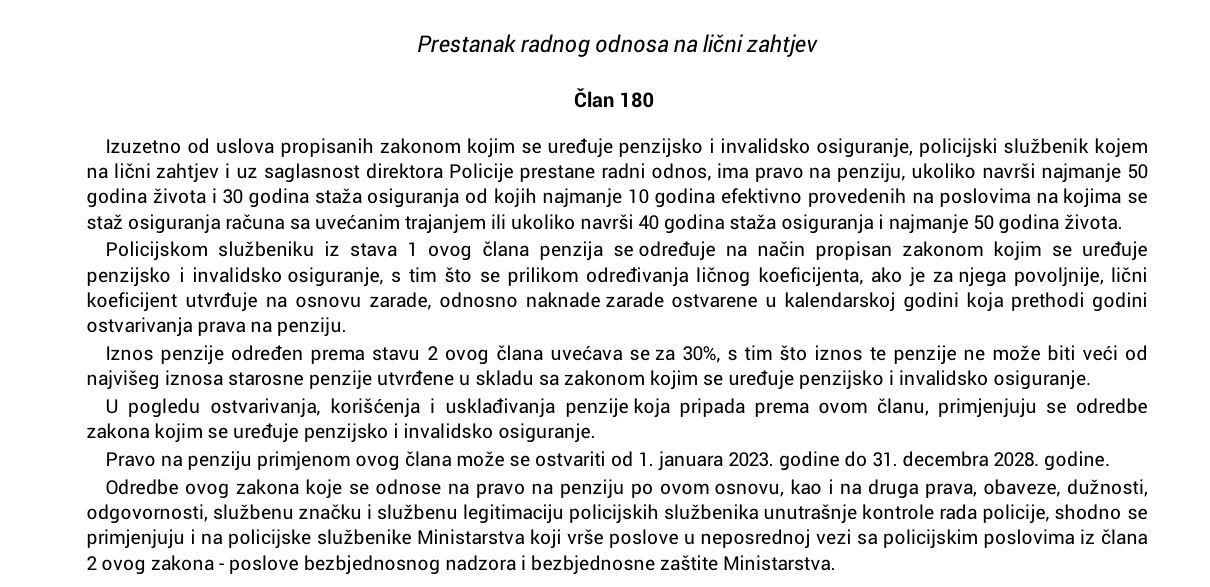
- In accordance with Article 180 of the Law on Internal Affairs, it is prescribed that police officers may retire under favorable conditions if they are at least 50 years old and have 30 years of pensionable service, of which at least 10 years must be in positions with extended service credit - states, among other things, the Law on Administrative Procedure.
SELECTIVITY OF POLICE LEADERS
It is precisely this legal option that the Democrats intend to use selectively - granting some officers the right to retire under favorable conditions while denying it to others.
According to information from the Police Directorate, the leaders of the Democrats are now considering a form of compensation: to accommodate a number of police officers facing disciplinary proceedings who are strongly defending themselves through their lawyers. All of this is aimed at preventing new, lengthy procedures - such as in the case of suspended police officer Milovan Pavićević.

REWARDS AND PUNISHMENTS
That is why police leaders have devised a kind of reward for certain suspended officers. All they need to do is accept early retirement, and they will receive certain benefits that had previously been denied to them.
These „disputed“ police officers have been told that disciplinary proceedings against them will be halted and that they will be paid the amount withheld due to suspension during the proceedings - 30 percent of their monthly salary. They have also been promised that, if they agree to leave the police, pension contributions will be paid for the period during which they were suspended.
Those well-informed about the background of this action note that it will be interesting to see the reasoning in decisions to suspend disciplinary proceedings. According to the law, disciplinary proceedings are suspended in three cases: if it is determined that no serious disciplinary offense was committed, if there is a lack of necessary evidence or procedural rules of evidence were violated, and the third case - if the statute of limitations for conducting the disciplinary procedure has expired.

WITHOUT ACCOUNTABILITY
Whether anyone will examine the legality of these decisions remains a major question.
So far, the Special State Prosecutor’s Office has not responded to as many as five criminal complaints filed by lawyer Veselin Radulović since August last year. There has also been no reaction from the SSPO to the criminal complaint filed in December last year by Milovan Pavićević against the leadership of the Ministry of Internal Affairs and the Police Directorate. Meanwhile, the Basic Court in Podgorica has held only two hearings so far in the mobbing lawsuit filed by lawyer Mihailo Volkov on behalf of suspended police officer Milovan Pavićević.
It appears that the fate of the allegedly unlawful vetting process is of little concern even to the European Commission, despite its announcement that it would closely monitor developments in a country leading in European integration. However, if Brussels has already issued a rather unusual recommendation - that unconstitutional laws on internal affairs and the National Security Agency should be adopted first and corrected later - it is quite possible that it will remain silent on what is described as a Stalinist persecution of politically unsuitable police officers.