




Juvenile suspected of drawing graffiti on the Embassy of Bosnia and Herzegovina and Argentina Square was arrested

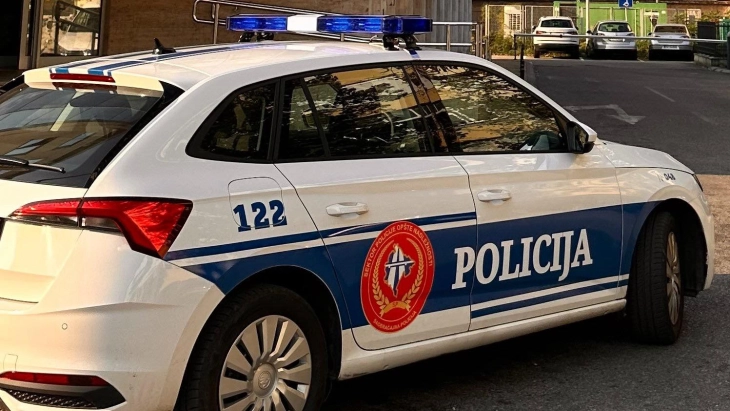
Police officers of the Podgorica Security Department arrested a juvenile (16) last night on suspicion that on December 16th, he wrote several graffiti on the Embassy of Bosnia and Herzegovina in Podgorica with messages glorifying the war crime in Srebrenica and graffiti with symbols that refer to hate speech, as well as Nazi symbols, drawn on a sign dedicated to the Jewish holiday of Hanukkah on Argentina Square, the Police Directorate announced.
According to the statement, the state prosecutor in the Higher State Prosecutor's Office in Podgorica was informed of the event, who ordered that a criminal complaint be filed against him on suspicion of having committed the criminal offense of inciting national, racial and religious hatred, by drawing graffiti on the embassy of Bosnia and Herzegovina in Podgorica on the night of December 16th.
- In relation to the drawn symbols on the board in Argentina Square, on the occasion of the celebration of the Jewish holiday, the competent state prosecutor in the Higher State Prosecutor's Office stated that there are no elements of a criminal offense in the that event. The police officers of the Security Department in Podgorica appreciated that the minor's actions contain the elements of being a misdemeanor from the Law on Public Order and Peace and arrested him - it is stated in the announcement.
He will be, along with a request to initiate misdemeanor proceedings, brought to the Court for Misdemeanors in Podgorica for further jurisdiction.
- The officers of the Police Administration will continue with the intensive implementation of measures and actions to identify and prosecute the perpetrators of crimes and misdemeanors that cause or encourage national, religious and racial hatred, intolerance and discrimination, with the aim of preserving public order and peace, protecting basic human rights and freedoms, as well as the safety of all citizens - the statement said.
Two days ago, the inscription "General, thank you for Srebrenica" appeared on the concrete fence of the Embassy of Bosnia and Herzegovina in Podgorica.
This scandalous message, which openly glorifies the genocide committed in July 1995 and the legally convicted war criminal Ratko Mladić, was strongly condemned by the Ministry of Foreign Affairs, stating that the heinous and unacceptable act is a direct attack not only on the diplomatic representation of a friendly country, but also on the fundamental values of civilization, the culture of memory and the dignity of the victims of the most serious crimes committed on European soil after the Second World War.
The Ambassador of Bosnia and Herzegovina to Montenegro Branimir Jukić told ETV Portal earlier that institutions reacted promptly, adding that the perpetrators caused a counter-effect and that such an act can only inspire the two countries to further strengthen their relations.
Jukić said that they immediately notified the police about the graffiti they discovered in the morning, and that a crime-scene investigation team reacted quickly and carried out its work. He noted that the Embassy was also contacted by Minister of Foreign Affairs Ervin Ibrahimović, as well as numerous citizens who condemned the act.
- There has truly been great solidarity from Montenegrin institutions and citizens who are calling the Embassy to express support, apologize, and condemn the inscription. I express my gratitude to the institutions and citizens, and this can only inspire us to strengthen good-neighborly relations - Jukić said in a statement to our portal.
As reported by the portal Istraga.ba on the social network X, in addition to the disputed inscription, a four-pointed cross was also drawn on the embassy wall - a symbol which, in this context, is associated with extremist and nationalist iconography.
The message on the Embassy represents a gross denial and relativization of the Srebrenica genocide, in which more than 8,000 Bosniaks were killed, and for which dozens of individuals have been sentenced to a total of 781 years in prison.
The genocide in Srebrenica was the culmination of a years-long policy of ethnic cleansing against Bosniaks. It was planned and carried out by the authorities of Republika Srpska, with direct support from the regime of Slobodan Milošević and the then Yugoslav Army. Men and boys were killed, as well as women, the elderly, and girls.
The Srebrenica genocide is not only a moral fact, but also a legal one: It has been confirmed by the International Court of Justice (ICJ), the International Criminal Tribunal for the former Yugoslavia (ICTY), and the Court of Bosnia and Herzegovina. Srebrenica is not a “tragedy” or a “crime” in an abstract sense — it is genocide, planned, ordered, and carried out.
To date, 54 individuals have been sentenced to a total of 781 years in prison, including five life sentences. Among those convicted are the highest military and political leaders of Republika Srpska and the Bosnian Serb army, including Ratko Mladić, Commander of the Army of Republika Srpska — life imprisonment; Radovan Karadžić, President of Republika Srpska — life imprisonment; Vujadin Popović, Chief of Security of the Drina Corps — life imprisonment; Ljubiša Beara, Head of Security of the VRS Main Staff — life imprisonment; and Drago Nikolić, security officer — 35 years in prison.
Numerous other members of the VRS, the RS Ministry of Interior, and civilian structures have been convicted before the Hague Tribunal and domestic courts.
After the executions, bodies were moved to secondary and tertiary mass graves. The aim was clear - to conceal the crime, erase the truth, and kill even the memory.
Last year, the United Nations General Assembly proclaimed 11th of July as the International Day of Remembrance of the Srebrenica Genocide.