




Milo Đukanović: We worked without a mistake from 1996 to 2006, even though no one in the world supported the idea of restoring Montenegrin independence
„I remembered, a few days after the referendum had ended, during my first meeting with Javier Solana in Brussels, something that Steve Hanke, an American professor and finance specialist who was, for a time, also my adviser, had told me earlier: „You will have to cross a high bridge with a swollen river beneath it. If you fall, no one will feel particularly sorry for you, if you make it across, everyone will welcome you as though they had been eagerly waiting to see you.“

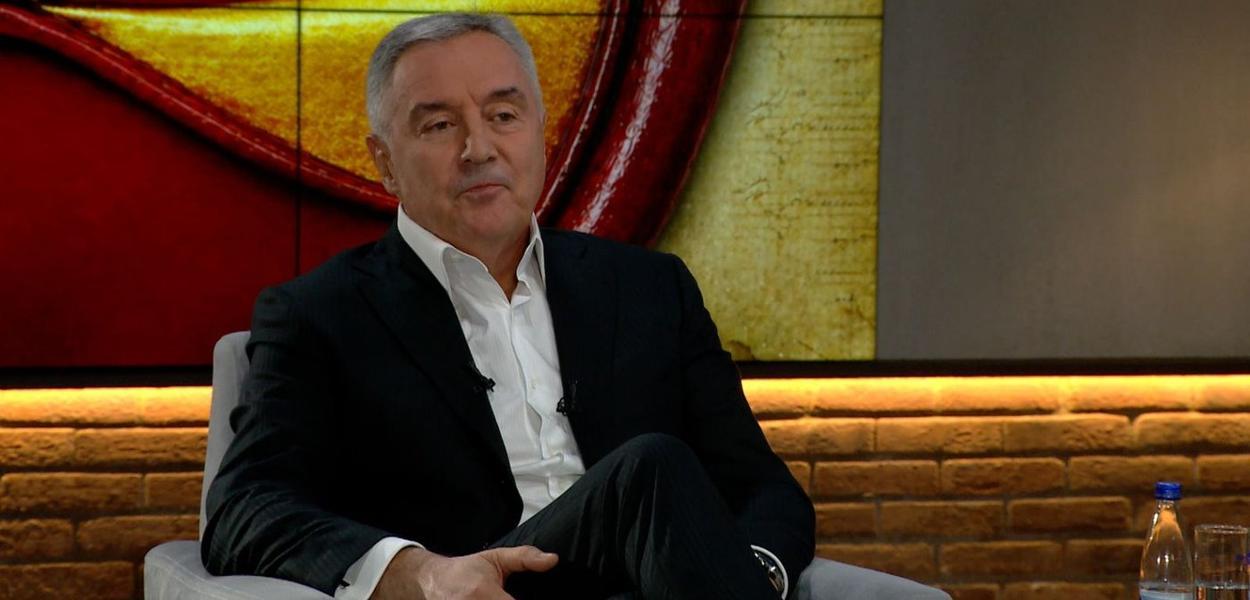
The hardest thing was to create a critical mass of support for the restoration of Montenegro’s independence within the Montenegrin public. From 1996 to 2006, we did not make a single mistake, even though we had no support anywhere in the world, said former Montenegrin President Milo Đukanović, longtime prime minister and leader of the Democratic Party of Socialists of Montenegro (DPS), and honorary president of the party, in a lengthy interview with Television E marking the 20th anniversary of the restoration of Montenegro’s independence.
In the program „Trag u vremenu” („A Trace in Time”), he recalled how Montenegro went from being the least developed republic of the Socialist Federal Republic of Yugoslavia, how it survived the collapse of the socialist system and the introduction of multiparty politics, how it endured as a captive of Greater Serbian policy, and how it returned to the path of Montenegrin independence. Where mistakes were made, what kinds of obstacles the country faced. Whether today’s Montenegro is understood in the context of the events and developments of the past 30 years.
Đukanović said that he does not share the perception held by a large part of the public that the 17 years leading up to the referendum were lost time for Montenegro. After the last realistic opportunity for the peaceful dissolution of Yugoslavia, and thus for the restoration of Montenegrin independence at the Hague Conference in 1991, came a period of bloody wars which, according to Đukanović, would not have bypassed Montenegro either, as it was at that time the most suitable ground for such a scenario.
-While the other Yugoslav republics, primarily Slovenia and Croatia, and I believe Macedonia as well, were preparing during the final years of Yugoslavia for an alternative to the common state, Montenegro continued to live in its Yugoslav idealism. The previous leadership did not want to accept the idea that the Socialist Federal Republic of Yugoslavia could disappear. But it was not only the Montenegrin leadership, I would also say that the overall Montenegrin public was not prepared for the end of Yugoslavia. To Montenegro’s great misfortune, a revolutionary change of government also occurred at that time. People who had honorably and competently carried out their duties over a long period after the Second World War then left the Montenegrin political stage. Montenegro was thus left without the necessary wisdom and state-political experience for the difficult trials that followed. Let us recall how important a factor in Slovenia’s stability during that period Milan Kučan was, or how valuable Kiro Gligorov was to Macedonia at that time. Likewise, how important Franjo Tuđman and later Stipe Mesić were for making
major political decisions in Croatia. Montenegro had no such support for making very difficult decisions, because a new generation of people suddenly and revolutionarily found themselves at its head, without sufficient not only political, but also life experience. I believe this is a significant part of the reason for certain mistakes Montenegro made in the early 1990s, during the escalation of the Yugoslav political crisis. The period from then until May 21, 2006, was a time in which Montenegro was preparing the ground for a peaceful separation from Serbia and the restoration of independence, to take control of its own future - said Đukanović.
Đukanović points out that there were numerous assumptions that had to be secured, the most demanding of which was creating a sufficient, that is, a critical mass of support for the restoration of Montenegro’s independence within the Montenegrin public.
- It was not that simple. Many analysts agree that the 1997 presidential elections were a historic turning point for modern Montenegro. Immediately after those presidential elections, we called extraordinary parliamentary elections in May 1998. In those elections, two coalitions clashed; one – sovereignist, civic, multiethnic, pro-European – won 170 thousand votes, while the opposing coalition, gathered around the Socialist People’s Party – let us freely call it the „pro-Milošević“ coalition, won 130 thousand. Therefore, the difference was 40 thousand votes. Less than three years later, the Government of Montenegro fell because of the withdrawal of the People’s Party from that government, after the Democratic Party of Socialists, as the backbone of that government, decided to change its program and, instead of advocating for Montenegro as an equal member of the Yugoslav federation, opted for the restoration of Montenegro’s independence. Because of this, we had to go to elections in April 2001, in which the difference in votes between the two opposing coalitions melted down to 5.5 thousand votes. That government lasted less than a year, in the meantime, we signed the Belgrade Agreement due to strong pressure from the European Union and their expectation that we accept the request to postpone the referendum, in return for their legitimization of the process, which we considered a key gain - he recalls.
Đukanović recalls the serious criticism from Montenegro’s sovereignist public following the signing of the Belgrade Agreement, but also the shift in the electorate, now in favor of the civic coalition, which followed in the elections of October 2002.
- The 35,000-vote difference in our favor was restored. All of this clearly testifies to the Montenegrin electorate's unpreparedness at the time to understand the inevitability of restoring independence. Further work on that issue was necessary. And we worked. I believe we worked well, and I dare say that, in the period from 1996, when movement in Montenegro’s state policy began, until 2006, we did not make a single mistake. And we had no supporters of the idea of restoring independence anywhere in the world, neither in the East nor in the West, neither in Europe nor in America. Unanimously, everyone was against Montenegrin independence, while in Serbia and among a part of the Montenegrin public, we faced hostility toward that idea. Had we ignored the need to continue working with the domestic public and ignored the European Union’s partnership offer at that moment, I am certain we would have wasted that opportunity. This way, we eventually reached the goal, those who doubted us and
those who believed it was better not to insist on independence accepted the outcome. I remembered then, several days after the referendum had concluded, during my first meeting with Javier Solana in Brussels, something Steve Hanke, the American professor and financial expert, who was at one point my adviser, had once told me: „You will have to cross a high bridge with a swollen river beneath it. If you fall, no one will pity you too much, if you cross that bridge, everyone will welcome you as if they had been eagerly waiting to see you all along” - Đukanović recalls.
Đukanović: Montenegrin Yugoslavism was the most sincere and most persistent, and for that, highly susceptible to manipulation
“Yugoslav idealism in Montenegro was a serious burden for a proper reading of what was happening in Yugoslavia at the time. “
Đukanović says that hardly anyone could have foreseen the bloody breakup of the former Yugoslavia and that, as much as they were aware of everything happening on the domestic political scene, they believed that reason would ultimately prevail and that, with the help of partners from the international community, the worst possible scenario would be avoided.
- I believe that Greater Serbian nationalism was the trigger that led to the wars in the territory of the former Yugoslavia, and which ended the Yugoslav political crisis. But I do not think that at that moment it represented a decisive factor on the political scene in Montenegro - said Đukanović.
According to him, the Montenegrin movement that led to the change of government in 1989 was ideologically very diverse.
- It certainly included Greater Serbian nationalism, but I do not think it was predominant. More dominant was Yugoslav idealism, and I believe that Montenegrin Yugoslavism was the most sincere, most persistent, and strongest compared to all other Yugoslav republics. Unfortunately, because of that, it was also highly susceptible to manipulation - Đukanović added.
That Yugoslav idealism, he says, was a serious burden for properly understanding what was happening at the time, amid very rapid changes on the Yugoslav political scene.
Đukanović says that the authorities in Belgrade were, in the midst of events, shifting to a new platform once they realized that Yugoslavia was lost.
- If there is no more Yugoslavia, then we will try to build a Greater Serbia on its ruins. Montenegro, in that turmoil, due to inexperience and being blinded by Yugoslavism, failed to register that change in time, and I believe that this significantly conditioned the initial confusion and some wrong decisions. We quickly freed ourselves from all those mistakes and illusions, but the consequences remained - Đukanović stated.
Đukanović: Bulatović was unconditionally tied to Yugoslavia in a way that insufficiently took into account Montenegro’s interests
Đukanović also revealed how the decision to accept Lord Carrington’s peace plan was changed.
- President Bulatović informed me that the previous night he had spoken with the leadership of Serbia, more precisely with the President of Serbia, Mr. Milošević, who confirmed to him that Serbia would also accept Lord Carrington’s plan. By the next morning, when the Hague Conference was starting, Serbia had changed its position. That is legitimate, and there is no need to discuss it. However, it is strange that President Milošević did not inform President Bulatović of that change, even though they were sitting at the same table at the Hague Conference. I consider that not only strange, but absolutely improper. You will remember what kind of campaign was then launched from Belgrade’s political and media circles against Montenegro and especially against President Bulatović – he recalls.
Đukanović notes that differences in political views with Bulatović were already visible even before the Hague Conference.
- Part of our differences also lay in our personalities. I have always been inclined toward tougher political formulations. I will remind you that on the eve of the Hague Conference I said in Parliament that Montenegro should assume all its sovereign competencies and then, from that position and with that portfolio, negotiate with those who wanted us to form some new Yugoslavia. President Bulatović was not inclined, at that time, to such radical ideas. He was, as I later reflected on him, unconditionally tied to Yugoslavia, to put it mildly, in a way that did not sufficiently take into account Montenegro’s interests. He was sincerely devoted to the idea of Yugoslavia without preconditions and without alternatives - Đukanović said.
Đukanović: I did not perform acrobatics just to stay in power at all costs
„I know many people who had brilliant ideas, but those ideas died before they even had a chance to be tested.”
Đukanović, in the interview, also commented on claims that he was a more skillful and pragmatic politician than most in the region, which allowed him to reshape his policies in accordance with prevailing trends.
- But what does it even mean to be a pragmatic politician? If we were to take the pejorative articulation of such a definition, one could assume that it refers to a person inclined to various political and moral acrobatics to remain in power. I would not say that such an interpretation can be applied to me - Đukanović said.
He recalled that he had refused the position of Secretary General of the League of Communists in 1989, the position of Prime Minister in 1991, and that he returned the mandate to President
Bulatović in 1996, after the parliamentary elections, when he attempted to influence the personal composition of the Government.
- Three times, after victories in parliamentary elections, I stepped down from power. Does this story speak of someone who would be ready to perform various acrobatics just to remain in a ruling position at all costs? I hope not. But if by pragmatism we mean the ability, through continuous analysis day after day, to recognize that there were fewer and fewer chances of ever establishing a functional two-member federation between such disproportionate members, additionally burdened by historical controversies in Serbian-Montenegrin relations. Then, if after all of that you conclude that there is no point in wasting more time on that experiment and publicly propose first to your party to change its program and, instead of advocating for Yugoslavia, move toward realizing the idea of independence, and undertake the difficult task of convincing the Montenegrin public, which was averse to uncertainty and unwilling to move into the unknown, then I of course accept such a characterization, if that is pragmatism - Đukanović was clear.
He further points out that after the end of the NATO bombing, he believed there was no longer any room for false hope that things could be repaired.
- We had a new war that Slobodan Milošević launched completely irrationally against the most powerful alliance in the history of mankind, the NATO alliance, solely to mobilize the support of the domestic public on the platform of confrontation with the international community. Without caring that by doing so, he was also causing enormous damage to Montenegro as one of the other member of the Federation. Then you realize that the sacrifice has come to an end and that you must change that strategic political orientation and move toward the restoration of independence. I know many people who had brilliant ideas, but those ideas died before there was even an attempt to seriously test them. Because the public that was supposed to accept and legitimize those ideas had not been properly prepared. It was a time of very complex politics and fundamentally different from today. If we make a mistake and fail to understand the specifics of that time, and if we fail to understand that the Montenegro of that period was not the Montenegro of today, then we will once again have a distorted picture and wrong conclusions that could perhaps lead to some wrong decisions for the future – Đukanović assessed.