




Convicted war criminal Ratko Mladić dead at 85

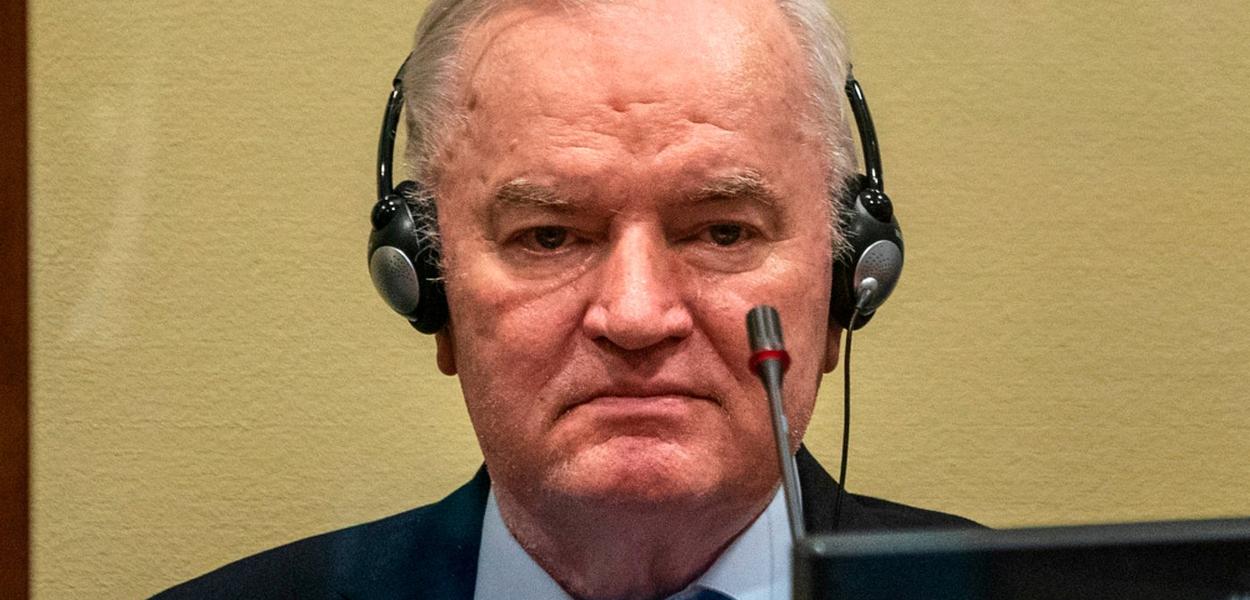
Convicted war criminal Ratko Mladić, who served as commander-in-chief of the Army of Republika Srpska, died today at the age of 85 in a Hague prison, Serbian media reported, as cited by Klix.ba.
Mladić had been ill for years, and in recent weeks his family, as well as the authorities in Serbia and the Republika Srpska entity of Bosnia and Herzegovina, had repeatedly attempted to have him transferred to Belgrade, where he would spend his final days.
Ratko Mladić, who was born in Kalinovik, was finally convicted in June 2021 by the International Criminal Tribunal in The Hague of the genocide in Srebrenica, persecution of civilians, extermination and murder, deportation and inhumane acts, terrorising the population of Sarajevo through shelling and sniping, and taking UN personnel hostage. The court found him guilty on 10 of the 11 counts of the indictment.
In the international public sphere, because of his atrocities, he also became known as the „Butcher of Bosnia“, and was directly responsible for the deaths of more than 8,000 men and boys in Srebrenica in 1995.
Criminals who served under Mladić’s command also spoke about the monstrous crimes and operations he ordered.
Despite extensive material and other evidence of the atrocities committed during the last war, Mladić unfortunately remains a hero to many in Serbia and in Bosnia and Herzegovina’s Republika Srpska entity.
After the war, Mladić spent 15 years in hiding, evading criminal responsibility, before being arrested on May 26, 2011, in Serbia, specifically in the village of Lazarevo near Zrenjanin.
He was arrested by members of Serbia’s Security Intelligence Agency (BIA) and the War Crimes Investigation Service, although many remain convinced that he lived freely for years because he was protected by individuals within Serbian institutions.
From the end of the war until his arrest, information about Mladić increasingly fuelled doubts about the Serbian authorities’ claims that they were unable to find and arrest him. Over time, the impression grew that he was being protected by individuals within state institutions and was therefore able to live freely.
That impression became even stronger following the deaths of two guards serving in the then Army of Serbia and Montenegro - Dragan Jakovljević and Dražen Milovanović - who were found dead on October 5, 2004, at a military barracks in Belgrade’s Topčider neighbourhood. Some believe the killings remain unresolved because the guards had seen the war criminal Mladić there. They consider this one of the indications that he was being protected by individuals within Serbian state institutions.
The killings significantly dispelled the hopes of those who had expected Mladić to be arrested soon after the fall of Slobodan Milošević’s regime and the election of a government that presented itself as democratic. Instead, the wait for his arrest continued for years, despite his capture being one of the key conditions for Serbia’s accession to the European Union.
Nor did the financial rewards offered for information leading to his arrest appear to help. Several months before his arrest, in October 2010, the Serbian government offered €10 million for such information.
Video footage broadcast in 2009 on the political programme 60 Minutes on Federal Television (FTV) convinced many even further that the war criminal Mladić was indeed being protected by the authorities in Serbia. The footage showed Mladić casually socialising, dancing, singing and posing for photographs among large numbers of people. In other words, the fugitive was living as a free man.