




Ibrahimović: Srebrenica still leaves us speechless, and reason struggles to find words
The objectives of the resolution, and therefore our responsibilities as accountable states and governments, are clear - to honour the victims, preserve the established legal and historical facts, ensure accountability, justice, and truth, and strengthen awareness of the crime of genocide. This awareness must extend beyond the genocide committed in Srebrenica by educating present and future generations so that genocide is never repeated anywhere in the world. It is evident that these are long-term processes that cannot be accomplished by a single generation alone - Ibrahimović said

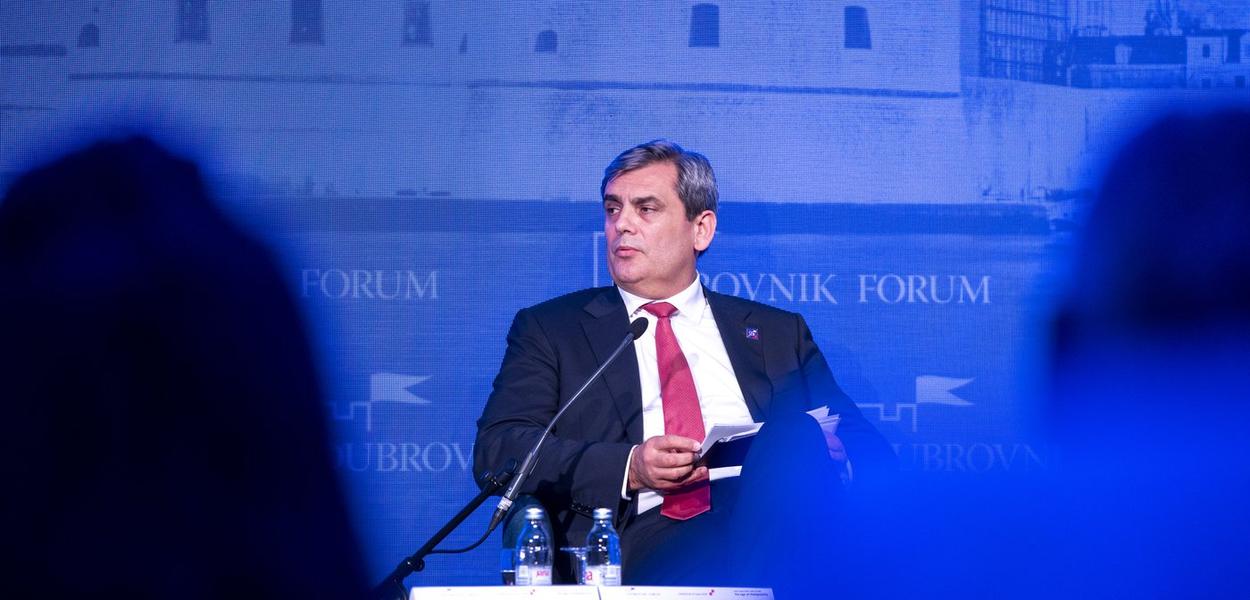
Thirty-one years later, Srebrenica still leaves us speechless, and reason struggles to find the words - Minister of Foreign Affairs and Deputy Prime Minister Ervin Ibrahimović said at an event held in the Eco Building to mark the International Day of Reflection and Commemoration of the 1995 Genocide in Srebrenica.
He invited those present to observe a minute of silence in memory of the 8,372 lives that were violently taken.
- May the victims rest in peace - Ibrahimović stated.
He said that today's panel, in line with the 2024 United Nations General Assembly resolution, reflects the commitment of the Ministry of Foreign Affairs of Montenegro to commemorate the International Day of Reflection and Commemoration of the Srebrenica Genocide every 11 July and to promote a stronger culture of remembrance and peace in Montenegro and beyond.
- It is our response to attempts at historical revisionism, the glorification of war criminals, and hate speech, phenomena to which, regrettably, Montenegro is not immune. It is also our decision to reaffirm, at the highest institutional level, our unwavering commitment to preventing the final stage of the genocide in Srebrenica, its denial and relativisation - he stressed.
Ibrahimović noted that Montenegro has repeatedly demonstrated its principled position regarding the events in Srebrenica in July 1995, both nationally and within all major multilateral forums, including the United Nations, the Council of Europe, the OSCE, NATO, and the European Union.
- I would like to recall the Declaration adopted by the Parliament of Montenegro endorsing the 2009 European Parliament Resolution on Srebrenica, the Resolution on the Genocide in Srebrenica adopted by the Parliament of Montenegro on 17 June 2021, and Montenegro's support for the aforementioned United Nations General Assembly resolution - he added.
According to Ibrahimović, the adoption of the 2024 United Nations resolution is of exceptional importance for Bosnia and Herzegovina and the countries of the former Yugoslavia, particularly for advancing transitional justice and fostering a culture of remembrance as an indispensable path towards healing in post-conflict societies.
- The objectives of the resolution, and therefore our responsibilities as accountable states and governments, are clear - to honour the victims, preserve the established legal and historical facts, ensure accountability, justice, and truth, and strengthen awareness of the crime of genocide. This awareness must extend beyond the genocide committed in Srebrenica by educating present and future generations so that genocide is never repeated anywhere in the world. It is evident that these are long-term processes that cannot be accomplished by a single generation alone – Ibrahimović said.
He recalled that, at a recent event organised by Human Rights Action, participants had the opportunity to hear historical perspectives on Srebrenica, including the assessment of Serbian historian Popović that the Srebrenica genocide is the most thoroughly documented crime in human history.
According to Ibrahimović, such findings, together with the conclusions reached by numerous international judicial institutions, impose an additional obligation to ensure through a systematic approach that discussions about the Srebrenica genocide are based on established historical and legal facts. This includes understanding the context in which the largest massacre in Europe since the Second World War took place, recognising its causes and consequences, and strengthening society's resilience to nationalist narratives and attempts to revise history. It also means ensuring that present and future generations understand that genocide was committed in Srebrenica and that 54 individuals have been convicted for these crimes, receiving a combined total of 781 years of imprisonment and five life sentences.
- The judgments of the highest international courts establish only individual criminal responsibility. Therefore, any attempt to attribute collective guilt or associate an entire people with the crime of genocide, whether here or anywhere else in the world, is nothing more than a rejection of the truth and an act of genocide denial - Ibrahimović stated.
He further noted that reports by the European Commission on the progress of individual countries in the region towards European integration, as well as reports by United Nations treaty bodies and the International Residual Mechanism for Criminal Tribunals in The Hague, demonstrate that the process of transitional justice, coming to terms with the past, truth, and accountability, has not yet been fully completed.
- I am convinced that sustainable peace in the region can only be achieved by confronting the darkest chapters of the past, establishing the truth, and bringing those responsible to justice. This is a prerequisite for building healthy societies that are resilient to all forms of human rights violations. By demonstrating our willingness to discuss the past and assume responsibility, we take another important step towards genuine understanding and reconciliation, and ultimately towards prosperity and unity for future generations in Montenegro and throughout the region - Ibrahimović said.
He concluded by recalling the words of Nelson Mandela, who addressed South Africa's Truth and Reconciliation Commission in early 1996, speaking of the immense weight of confronting the past and the profound impact the Commission's work would have on the country's future.
- Mandela spoke of the criticism they often faced for refusing to accept the argument that the past should simply be forgotten. On the contrary, he maintained that while forgiveness is possible, forgetting is not. The choice facing his nation was never whether to uncover the past, but how to ensure that the truth would emerge in a way that promotes reconciliation and peace. In this context, I would like to conclude by expressing my profound gratitude to the Director of the Srebrenica Memorial Center, Emir Suljagić, for participating in today's event through a video message and for the Memorial Center's vitally important contribution, under his leadership, to preserving the memory of and the truth about the victims of Srebrenica - Ibrahimović concluded.