




Nikolić: The fate of the anti-Montenegrin three-party coalition depends on the Bosniak Party and Albanian parties
Montenegro today is a country that effectively has no prime minister, except on paper. Milojko Spajić has today become a „button-pressing prime minister“ for Andrija Mandić and Boris Bogdanović. The passage of time, culminating in the adoption of these laws, has probably convinced us that there are no political or ideological differences between the Europe Now Movement, the New Serbian Democracy and the Democrats. This government, which by its very nature is anti-Montenegrin, can and must be replaced in the next parliamentary elections in order to move beyond the institutional and political crisis we are living through - Nikolić said

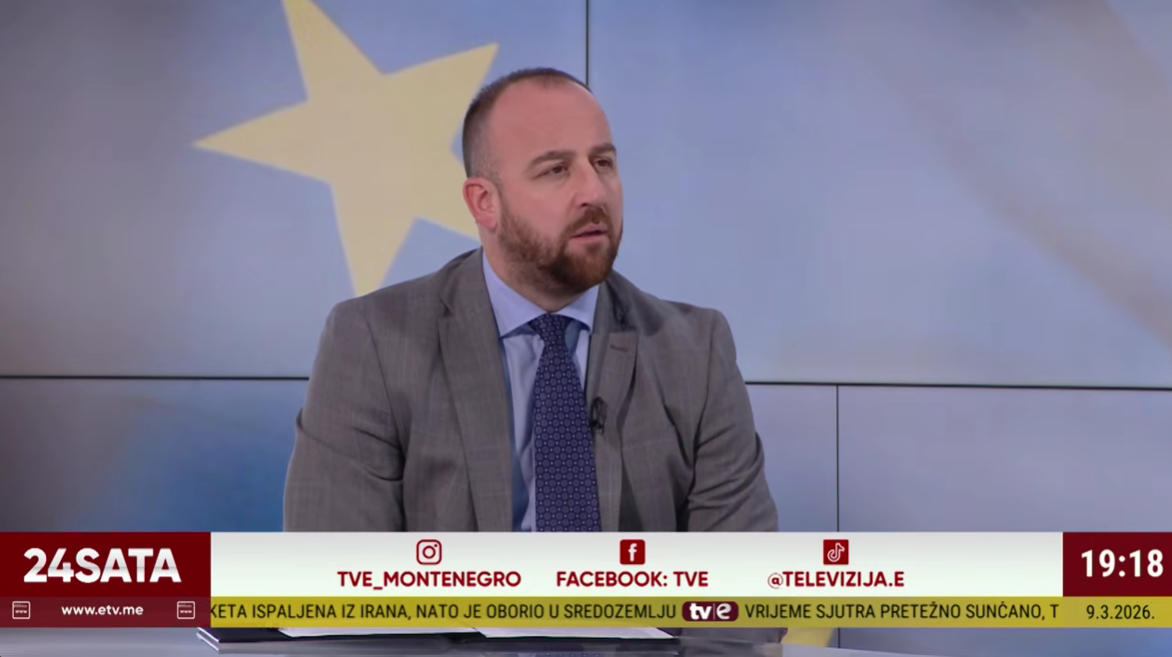
The head of the parliamentary group of the Democratic Party of Socialists (DPS) in the Parliament of Montenegro Andrija Nikolić said that the survival of the anti-Montenegrin three-party coalition largely depends on the support it receives from the Bosniak Party and Albanian parties.
- The controversial legal amendments, which prompted the opposition to leave parliamentary committees, were also adopted thanks to the decisive support of minority parties. Without their votes, the ruling majority would have only 38 MPs. The solution for overcoming the crisis is a high turnout of dissatisfied citizens in next year’s elections - Nikolić said while appearing on the central news programme „24 Sata“ („24 Hours“) on Television E.
Resignations and DPS withdrawal from committees
Member of Parliament from the Democratic Party of Socialists Ivan Vuković today resigned from the Committee on European Integration. The party also announced it would withdraw from the Committee on Electoral Reform, as well as remove Nikola Rakočević from the position of Deputy Speaker of Parliament following the adoption of amendments to the laws on the Ministry of Interior and the National Security Agency.
- Enough with the simulation of democracy - Nikolić said, referring to the actions of the ruling majority.
The DPS MP added that the party no longer intends to participate in the political marketing of a government that invokes European standards while simultaneously adopting laws that override the Constitution of Montenegro and European Union conventions on human rights.
Crossing the „red line“
- Until now, thanks to the wisdom of the opposition and the responsibility we feel toward state interests, the dialogue had produced certain results. However, recent developments, symbolised by the adoption of a law that legalises the persecution of political dissenters and undermines a fundamental principle of the rule of law - the presumption of innocence - suggest that we have crossed a red line. Does this ultimately mean that institutional dialogue between the government and the opposition has been extinguished? It does. It was extinguished by the parliamentary majority, that is, by the Government - Nikolić said.
European integration and the political context
Commenting on a statement by Minister of European Affairs Maida Gorčević that the DPS withdrawal from parliamentary committees will not affect the course of EU integration, Nikolić said the minister fails to recognise the importance of the country’s political context, which he noted is in the final phase of European integration.
- This is an attempt to relativise and minimise the overall contribution the opposition has made to move the country faster toward the European Union. This is also supported by today’s statement by Chair of the European Parliament’s Committee on Foreign Affairs, David McAllister, who said that EU membership cannot happen without broad social and political consensus within the country. Should we be reminded that many of the results the government now boasts about in the field of European integration would not have been possible without the state-responsible role of the opposition, primarily the DPS? The problem for Montenegro’s European path is not the opposition’s resignations, the problem is the Government of Montenegro in which Minister Gorčević sits. Now the keys to European integration are in the hands of Andrija Mandić, so we will see how that looks - Nikolić said.
Reaction of the EU and the opposition
Nikolić believes that the EU’s message that the adopted laws could later be amended in some way encouraged the ruling majority, as it was sent in order to preserve the „European link“.
- If the EU had given a negative response, I believe there would have been a restructuring of the political scene that would have slowed down the European path. The European Union did turn a blind eye and acted contrary to the principles on which the negotiation process is based. It is difficult to understand that something is not fully aligned with the EU acquis, but that you can still adopt it for the sake of the stability of the ruling coalition and then align it afterwards - Nikolić stressed.
He recalled that the opposition had maintained regular communication with the EU delegation in Montenegro and warned of the possible consequences of adopting the controversial legal solutions, which initially had an effect because the parliamentary session was postponed. However, the laws were ultimately adopted, and the opposition will continue discussions in Brussels.
„Milojko Spajić has become a button-pressing prime minister“
Nikolić said Montenegro is experiencing the culmination of a political crisis that has lasted for six years, while the appearance of normality had been maintained thanks to the constructive approach of the opposition.
- Montenegro today is effectively a country without a prime minister, except on paper. Milojko Spajić has become the button-pressing prime minister for Andrija Mandić and Boris Bogdanović. The passage of time, culminating in the adoption of these laws, has likely convinced us that there are no political or ideological differences between the Europe Now Movement, the New Serbian Democracy and the Democrats. This government, which by its very nature is anti-Montenegrin, can and must be replaced in the next parliamentary elections in order to move beyond the institutional and political crisis we are living through - Nikolić said.
Support for journalism
Nikolić also expressed particular respect for journalists and media outlets that, despite pressure and persecution of dissenting voices, continue to uphold free and independent journalism in Montenegro.
- I would like to say that I have special respect for journalists and editorial teams who endured persecution, labelling and detentions in order to preserve what is the key reflex of the journalistic profession - the right to ask questions, the right to criticise and the public’s right to know. I am primarily referring to Television E, Antena M, Standard, Portal Analitika and CDM - all media outlets that today carry the torch of free and independent journalism in Montenegro - Nikolić concluded.