




Schmidt: Montenegro and Albania can be beacons of success; Janković: Their EU accession must not create new divisions in the region

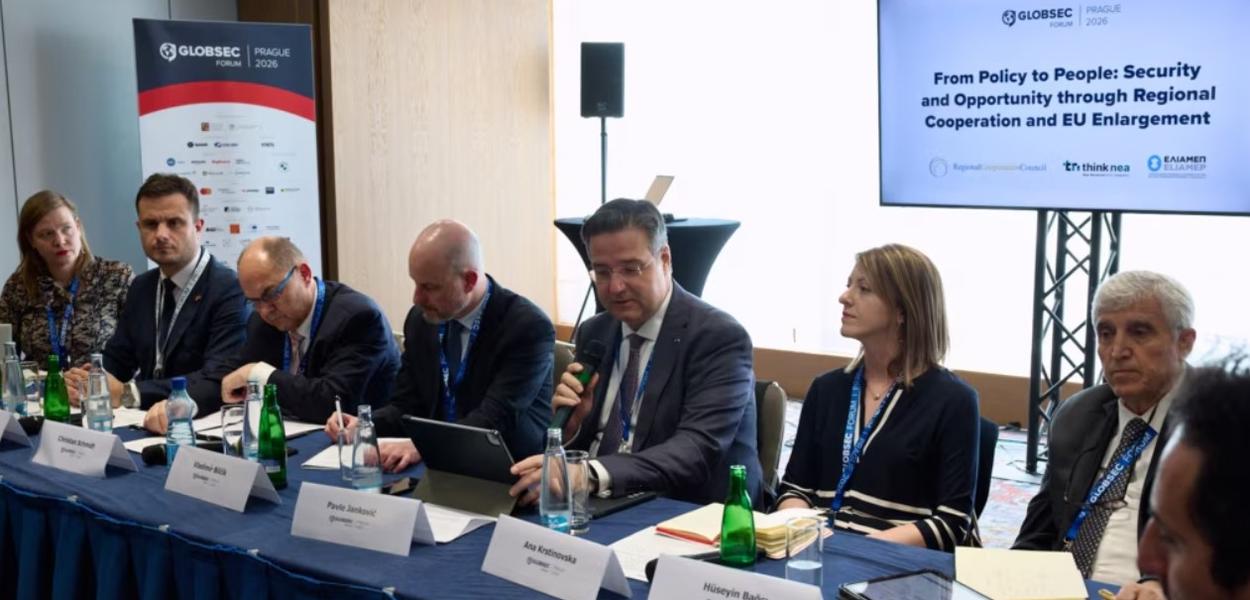
There is optimism regarding the accession of two Western Balkan countries, Montenegro and Albania, to the European Union (EU), participants said during a panel discussion on EU enlargement held as part of the international GLOBSEC forum in Prague.
However, panel participants also assessed that the accession of these two countries to the EU could deepen divisions within the Western Balkans region.
They further stressed that the enlargement of the Union to include this region would have a positive impact not only on candidate countries, but also on the security and economies of EU member states.
The panel discussion titled „From Policies to People: Security and Opportunities Through Regional Cooperation and EU Enlargement“ was held within the framework of the Central European security conference taking place in Prague from May 20 to 23, 2026.
People in the Western Balkans still see their future in the EU
Pavle Janković from the Regional Cooperation Council emphasized that surveys conducted by the organization in Western Balkan countries show that citizens of the region consider both regional cooperation and European Union membership to be important.
The 2025 „Balkan Barometer“ survey conducted by the Regional Cooperation Council showed that public support for EU membership increased across Western Balkan countries during 2025.
According to the survey, 64 percent of citizens of the so-called Western Balkan Six (Montenegro, Serbia, Bosnia and Herzegovina, Albania, Kosovo, and North Macedonia) believe that EU membership would be beneficial for them, which is ten percentage points higher than in 2024.
Support for EU accession is strongest among citizens of Albania (86 percent) and Kosovo (78 percent). On the other hand, Serbia recorded the lowest level of support in the region, at 42 percent.
The survey also showed that most citizens view regional cooperation in the Western Balkans as „an important driver of progress“ in the fields of politics, economics, security, and overall well-being.
- This tells us that, despite frustrations, slow reforms, and political tensions, people still see their future in the European Union. But they expect more than mere declarations - they expect jobs, mobility, security, predictability, less corruption, and more opportunities - Janković stressed.
He cited examples of practical regional cooperation that directly benefit ordinary people, such as the abolition of roaming charges within the Western Balkans and the possibility of traveling within the region using only identity cards.
The danger that „one country’s success becomes another’s problem“
Janković warned that regional cooperation must continue even after some of these countries join the Union.
- The future accession of one or two Western Balkan economies to the European Union must not create new divisions in the region. If Montenegro advances first, followed by Albania, regional cooperation should not weaken but rather become more relevant, flexible, and mature - he stated.
Christian Schmidt, the outgoing high representative for Bosnia and Herzegovina, agreed with Janković.
- I believe Montenegro and Albania truly can become beacons of success in the coming years, but we must be very careful that the success of some does not become a problem for others - Schmidt emphasized.
Huseyin Bagci, a professor at Middle East Technical University, added that it is equally important for citizens of Balkan countries to enjoy equal status once they join the European Union, rather than feeling „like an addition the EU is accepting out of charity“.
What are the three possible scenarios?
Ana Krstinovska, a researcher at the Hellenic Foundation for European and Foreign Policy, said there are three possible scenarios for the next ten years.
The most optimistic scenario would see all Western Balkan countries become full EU members.
The second, „middle“ scenario would involve only Montenegro and Albania becoming members within the next decade. Krstinovska agreed with other panelists that this could create a new dividing line in the region, but at the same time it would signal that the enlargement policy still exists and would motivate other Western Balkan countries to approach their reform agendas more seriously.
The third scenario, she said, would be the most unfavorable both for the region and for the European Union - a scenario in which none of the Western Balkan countries become EU members.
Krstinovska believes the European Union is already losing by failing to enlarge into the Western Balkans. She cited the example of critical raw material production.
- Relative to its size, the Western Balkans is a significant producer of copper. However, most of that copper, especially from Serbia, ends up in China - in the hands of one of the EU’s biggest economic competitors. At the same time, the EU imports copper from Latin America, from Brazil and Chile, which entails major logistical costs as well as additional risks linked to global geopolitical uncertainty - Krstinovska explained.
She said the Western Balkans currently provide around three percent of the EU’s copper needs, and that this figure could rise to eight percent.
She also noted that a similar situation applies to aluminum, „especially from Montenegro and Bosnia and Herzegovina, which also largely ends up in China“.
Uneven progress of countries on the path toward the EU
Panel participants repeatedly expressed optimism regarding the near-term accession of Montenegro and Albania to the European Union.
These two countries have emerged as leaders in the European integration process - Montenegro is closest to membership, having opened all negotiation chapters and aiming to close negotiations by the end of 2026, while Albania is progressing the fastest in the region despite not yet entering the chapter-closing phase.
In contrast, Serbia has faced stagnation since 2021 due to a combination of factors - primarily relations with Kosovo, but also problems concerning the rule of law, the state of democracy, and alignment with the EU’s foreign policy. Four years after the start of Russia’s invasion of Ukraine, Serbia remains among the few European countries that have not imposed sanctions on Russia.
Accession negotiations are also blocked in the case of North Macedonia, which, despite major compromises such as changing the country’s name at Greece’s request, remains blocked because of a bilateral dispute with Bulgaria.
Bosnia and Herzegovina and Kosovo remain in earlier stages of the process, where progress is limited by structural and political challenges.
Bosnia and Herzegovina has not fully implemented any of the key 113 reforms it committed to under the Reform Agenda approved by the European Commission in December last year. Bosnia and Herzegovina pledged to implement reforms in 26 areas by 2027, encompassing a total of 113 measures. A key component of those reforms concerns strengthening the judiciary.
Kosovo still lacks candidate status, primarily because of its unresolved relationship with Serbia and the fact that five EU member states do not recognize Kosovo’s independence. During a recent visit to Kosovo, EU Enlargement Commissioner Marta Kos also pointed out that many reforms had stalled due to repeated elections in Kosovo during 2025.
A discussion has recently opened regarding alternative models for integrating Western Balkan countries into EU economic structures.
EU member states Austria, the Czech Republic, Italy, Slovakia, and Slovenia advocate the gradual integration of candidate countries into the EU single market as a way to maintain enlargement momentum and accelerate reforms. A non-paper reviewed by Radio Free Europe/Radio Liberty states that step-by-step market access would encourage economic integration and regulatory harmonization while preserving the perspective of full EU membership.
The idea of integrating Western Balkan countries into the European single market was put forward in February 2026 by Serbian President Aleksandar Vučić and Albanian Prime Minister Edi Rama. In a joint opinion piece for the German newspaper Frankfurter Allgemeine Zeitung, they argued that countries of the region do not need to receive full political membership in the EU immediately, but should first be integrated into the European single market and the Schengen Area.