




Nikolić: We are sending the initiative to dismiss Mandić to parliamentary groups today, procedure for convening an extraordinary session to follow
We are convinced that the way Andrija Mandić has continuously performed his duties, and particularly his latest action concerning the death of Ratko Mladić, is incompatible with the political and institutional responsibility of the speaker of the legislative chamber of a country that is expected to become the next member of the European Union - Nikolić said

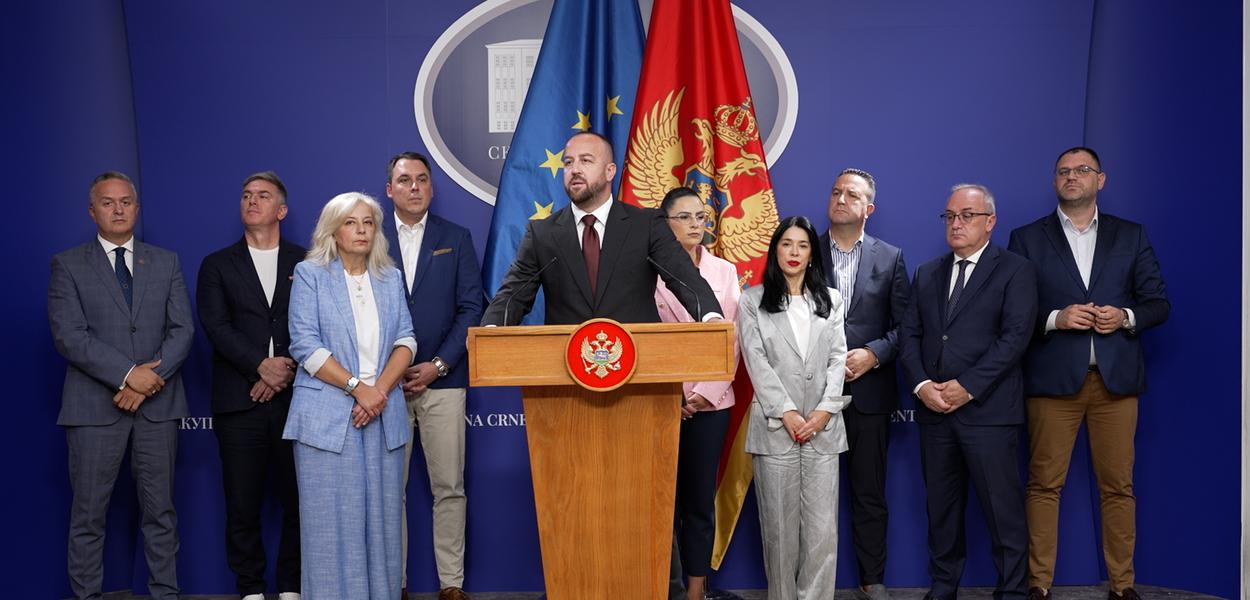
The Democratic Party of Socialists will submit an initiative to dismiss the Speaker of the Parliament of Montenegro, Andrija Mandić, today to all parliamentary groups, after which the procedure for convening an extraordinary session of Parliament will be launched – the head of the parliamentary group of this political party, Andrija Nikolić, announced at a press conference.
He said the immediate reason for submitting the motion was Mandić’s decision to publicly offer condolences following the death of Ratko Mladić, who was sentenced to life imprisonment by a final judgment for genocide in Srebrenica, crimes against humanity and other war crimes committed during the war in Bosnia and Herzegovina.
Reading out the text of the initiative to dismiss Mandić, Nikolić stressed that the position of Speaker of the Parliament of Montenegro entails special political and institutional responsibility, as well as an obligation to preserve the reputation and integrity of the representative body of all citizens.
- Mandić has, however, throughout his term, continuously used the authority of this position to promote views that deepen social divisions, while his actions have simultaneously damaged the reputation of Parliament and Montenegro’s international credibility. Such conduct is sufficient reason for Parliament to once again consider the issue of his political accountability and whether he retains the confidence required to continue serving as Speaker - Nikolić said.
He added that the fact that the condolences were sent in Mandić’s personal and party capacity cannot be separated from the fact that he holds the office of Speaker of the Parliament of Montenegro.
- The Speaker of Parliament is not merely a representative of a political party, but the holder of an office that entails special institutional responsibility, the protection of Parliament’s reputation, and respect for the values upon which Montenegro’s constitutional order and its commitment to becoming the next EU member state are based. Expressing respect for a war criminal convicted by a final judgment, particularly a person convicted of genocide in Srebrenica, is incompatible with the responsibility attached to the office of speaker of the parliament of a state that is obliged to respect the judgments of international courts, foster a culture of remembrance, and contribute to reconciliation and good-neighbourly relations - Nikolić stated.
International reputation
The seriousness of such an action and its consequences for Montenegro’s international credibility, he said, are also confirmed by reactions from the country’s European partners.
- The European Commission, responding to statements by Montenegrin politicians following the death of Ratko Mladić, unequivocally stated that any glorification of war criminals is contrary to the most fundamental European values and has no place either in the EU or in candidate countries. The European Commission also recalled that Ratko Mladić was serving a life sentence for crimes against humanity and genocide in Srebrenica, clearly identifying him as a war criminal - Nikolić said.
According to him, the official reaction of the Republic of Croatia, an EU member state with which Montenegro shares a border and whose consent, he reminded, will be necessary during the final stages of the European integration process, was particularly significant.
- The Croatian Ministry of Foreign and European Affairs deemed the condolences expressed by the Speaker of the Parliament of Montenegro following the death of Ratko Mladić unacceptable and contrary to the values on which the EU is founded. At the same time, Croatia stated that during the accession negotiations it would insist on confronting the past, prosecuting war crimes, respecting the decisions of international courts, and maintaining good-neighbourly relations, while warning that such messages do not contribute to Montenegro’s European path - Nikolić said.
He added that when the actions of the speaker of the parliament of an EU candidate country provoke such reactions from EU institutions and a neighbouring EU member state, they can no longer be presented as a matter of his personal or party beliefs.
- It becomes a question of political accountability for the reputation of the institution he represents and for the consequences his actions have for Montenegro’s national interests. This event, however, is not an isolated incident, but rather a continuation of the manner in which he has exercised his office, which is why the issue of the Speaker’s political accountability has already been raised twice during this parliamentary term - Nikolić said.
A longstanding problem
According to Nikolić, Mandić’s term has been „marked by longstanding problems in the organisation of Parliament’s work and the exercise of its oversight function, a selective approach to Montenegro’s state holidays and symbols, as well as the use of the Speaker’s office to promote political and ideological positions that do not reflect the values and interests of all the citizens whom Parliament represents“.
- The irresponsible approach to parliamentary procedure was particularly evident in the adoption of important legislation without genuine parliamentary debate, including the Law on Weapons and Ammunition, which, despite the Speaker’s earlier announcement that it would not be discussed that day, was placed back on the agenda shortly before midnight on 31 July and adopted just before the end of the regular parliamentary session - Nikolić recalled.
He said that such practices reduce parliamentary debate to a mere formality, undermine democratic procedures, and deprive citizens of their right to exercise genuine influence, through their representatives, over the adoption of laws that directly regulate their rights and obligations.
- Particularly concerning is the Speaker’s attitude towards Montenegro’s state holidays and national symbols. The failure to issue congratulations on 21 May, Independence Day, one of the country’s most important national holidays, as well as the manner in which certain events have been organised under the auspices of the Parliament of Montenegro, including the commemoration of the Battle of Fundina using symbols that are neither official state symbols nor historically authentic symbols, further confirms a practice in which the authority of Parliament is misused to promote his own ideological and identity-based interpretations - Nikolić said.
The right to hold beliefs
The Speaker of Parliament, he noted, has the right to hold political and ideological beliefs, just like any other citizen or MP.
- However, holding the office of speaker of the representative body of all citizens entails a higher degree of responsibility, institutional restraint, and awareness that his actions affect the reputation of Parliament, relations within Montenegro, and the country’s international standing. Montenegro is at a decisive stage in its EU accession process. European integration is not merely a matter of meeting technical benchmarks and adopting legislation; it also means belonging to a system of values that entails an unequivocal attitude towards war crimes, respect for the decisions of international courts, fostering good-neighbourly relations, and responsibly confronting the past - Nikolić said.
For that reason, they believe that the Speaker’s latest action crossed a line beyond which, he stressed, the question of his accountability can no longer be relativised by the need to preserve the parliamentary majority or political stability.
- We are convinced that the way Andrija Mandić has continuously performed his duties, and particularly his latest action concerning the death of Ratko Mladić, is incompatible with the political and institutional responsibility of the speaker of the legislative chamber of a country that is expected to become the next member of the European Union. In light of all the above, we believe that Mandić lacks the political and institutional credibility necessary to perform one of the country’s most responsible public offices. We therefore call on MPs of the Parliament of Montenegro to support the motion for his dismissal - Nikolić stressed.
How to secure support
Asked how they expected to secure support for the initiative, Nikolić said that he did not wish to prejudge how MPs would vote at this stage.
- I think the entire parliamentary majority has been caught off guard and that they never imagined that a condolence message following the death of a war criminal would trigger such an avalanche of reactions from both the domestic and international public. I think that this development has exposed the political substance of those who have already made their position known, such as the Europe Now Movement, which has said it will not support the initiative - much more than it has given us any new insight into Andrija Mandić - Nikolić said.
He added that the spotlight of the European Union is now on the Montenegrin Parliament and that the question of dismissing Andrija Mandić is not merely a question of his removal from office, but a question of attitudes towards universal values, namely - whether Ratko Mladić is a hero who should be cheered, celebrated and honoured, or whether Ratko Mladić is a war criminal.
- I believe that this fact will also help us, in the coming days, perhaps to establish the moral position of individual MPs. Because, let me repeat once again, this is not only a political issue; it is also a question of morality - Nikolić said.
Procedure
As he explained, a minimum of 10 signatures is required to initiate the dismissal of the Speaker of Parliament, while 27 signatures are needed if they wish to have the session convened as an extraordinary sitting, that is, before the end of September.
- That will probably be the case. Following this press conference, the initiative will be sent to all parliamentary groups, and I believe that within the next day or two we will receive feedback from MPs who are interested in signing the initiative. After that, we will launch the procedure for convening an extraordinary session - Nikolić said.
J. B.